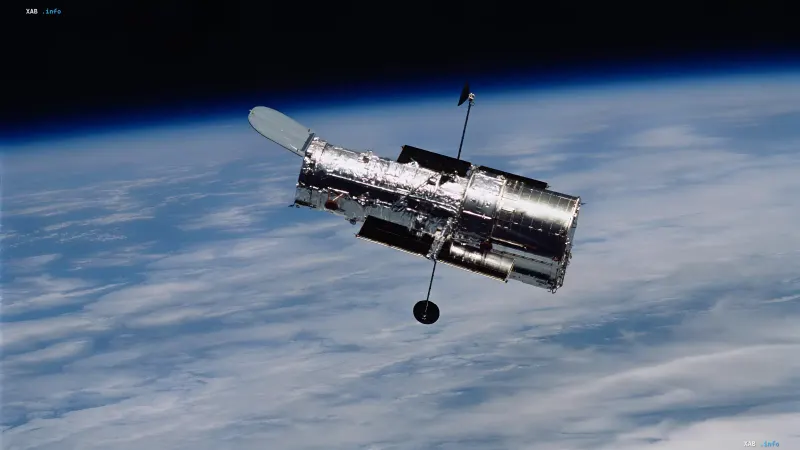
NASA has requested proposals from commercial space companies for servicing the Hubble Space Telescope, launched in 1990. The primary option under consideration is to boost the observatory to a higher orbit to slow its gradual descent and extend its scientific operations. If no action is taken, the telescope could re-enter Earth's atmosphere between 2033 and 2034. The agency itself expects to carry out an orbit correction mission no later than 2032, making the decision-making window increasingly narrow.
Why Hubble Is Losing Altitude
The reason for the decaying orbit is atmospheric drag from the upper layers of the atmosphere. Despite the extremely low air density at the telescope's working altitude, it gradually slows the spacecraft down. Hubble lacks its own propulsion system, meaning it cannot independently compensate for the loss of altitude. This is why NASA is inviting companies to consider not only boosting the observatory but also upgrading its hardware to continue scientific observations. Simultaneously, the agency is prepared to study options for a safe, controlled de-orbit of the spacecraft if extending its operation proves technically or economically unfeasible.
Condition of Onboard Systems
An added complexity is the condition of the onboard systems. In June 2024, NASA switched Hubble to operate on a single-gyroscope mode out of the six installed. Gyroscopes help determine the telescope's orientation and precisely point it at selected astronomical targets. By that point, after more than three decades of operation, three instruments remained functional, with one of them beginning to output anomalous readings. Another healthy gyroscope was placed in reserve to preserve its potential use in the future.
The Legacy of Manned Servicing
Hubble was originally designed with the expectation of servicing by astronauts directly in orbit. Throughout its operational history, NASA conducted five repair and modernization missions. The final one was planned before the Space Shuttle Columbia disaster in 2003, after which the servicing program had to be overhauled. In 2009, astronauts did travel to the telescope: they replaced batteries and performed other tasks that extended its lifespan. No further manned missions to the observatory have been conducted since.
The Commercial Path and Past Attempts
NASA has previously considered engaging private companies to boost Hubble. In 2022, the agency signed an unfunded Space Act Agreement with SpaceX to study the feasibility of using the Dragon spacecraft to move the telescope into a more stable orbit. At the time, this was strictly a study of the technical and commercial viability of the project rather than preparation for a NASA-funded rescue mission. The agency also has more recent experience with similar attempts: in September 2025, NASA tasked Katalyst Space Technologies with preparing an orbital boost for the Swift space observatory, which was losing altitude faster than expected. However, the company's spacecraft, launched in July, encountered an attitude control system failure, forcing the mission to be terminated. On November 4, the Swift observatory re-entered the atmosphere over Indonesia.
Leadership Perspective and Outlook
NASA Science Mission Directorate Deputy Associate Administrator Nicky Fox called Hubble a U.S. national asset and stated that the agency wants to explore all available options to extend its operation while developing the next flagship observatory. NASA Administrator Jared Isaacman also emphasized that the agency intends to look into cost-effective ways to extend the lifespan of spacecraft already in orbit. If the boost succeeds, Hubble will be able to continue observations for several more years, significantly increasing the scientific return from one of the most productive telescopes in the history of astronomy.