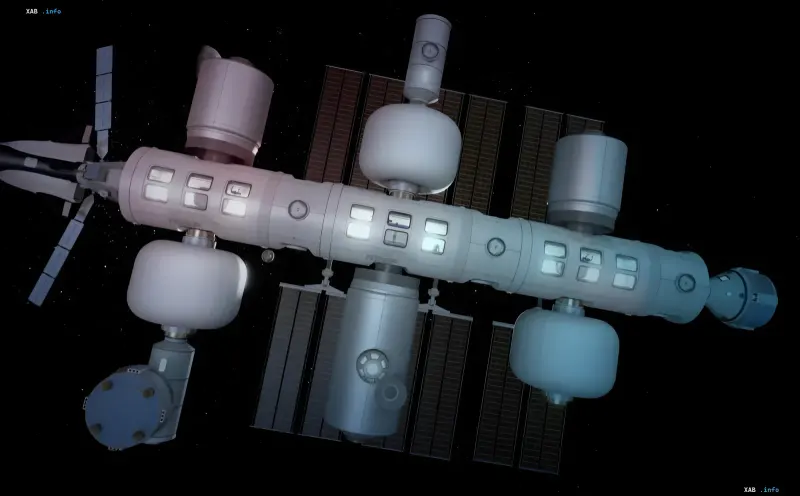
Blue Origin has announced its withdrawal from NASA's Commercial LEO Destinations (CLD) competition, through which the agency is selecting a contractor to build and operate a commercial crewed station in low Earth orbit. The decision means that the Orbital Reef project, which Blue Origin was developing jointly with Sierra Space, will no longer contend for support in the second phase of the program. In 2021, the consortium secured one of the three Phase 1 CLD contracts, but the company now intends to redirect resources toward developing technologies and infrastructure for long-term human presence on the Moon and transporting crews to Earth's satellite.
Reasons for the Decision: Expanding Role in the Artemis Program
In an official statement, Blue Origin explained its departure by pointing to its expanding role in NASA's Artemis program and lunar base construction projects. According to company representatives, concentrating efforts on lunar directions will accelerate the development of key technologies needed for a sustainable human presence beyond Earth orbit. At the same time, Blue Origin is not ending its cooperation with NASA: the company remains one of the agency's primary contractors for lunar transportation services, including delivering astronauts to the lunar surface. Furthermore, Blue Origin maintains a separate agreement with NASA to develop technologies and equipment for a crewed spacecraft.
Context: What Is CLD and Why Is It Needed
The CLD competition was launched by NASA to prepare a replacement for the International Space Station, whose operation is scheduled to conclude in 2030. The program envisions creating commercial crewed infrastructure in low Earth orbit to ensure the continuity of U.S. presence in space after the ISS is decommissioned. Alongside Orbital Reef, initial participants in the competition included Voyager Technologies' Starlab project and Northrop Grumman's proposal. In October 2023, Northrop Grumman also withdrew from the competition and joined the Starlab team, which now operates as a joint venture between Voyager Technologies and Airbus. Axiom Space offers a separate station project: its modules are initially scheduled to dock with the ISS before detaching to operate independently. NASA has also entered into an unfunded Space Act Agreement with startup Vast, which plans to launch an early version of its Haven-1 station into orbit in the first quarter of 2027.
Phase 2 of the Competition: Timeline and Terms
NASA announced Phase 2 of the CLD competition on October 9, 2026. The agency intends to award multiple fixed-price, indefinite-delivery/indefinite-quantity contracts. It first plans to support at least two companies during early development stages, followed by a secondary competition for final design, testing, evaluation, certification, and commercial station services. The application window is open until December 8, 2026, and NASA expects to announce results around April 2027. Blue Origin's exit from the competition means its Orbital Reef project will not participate in this phase, effectively reducing the number of contenders for key contracts.
What This Means for the Commercial Orbital Station Market
Blue Origin's departure significantly shifts the competitive landscape in the race to build a commercial orbital station. The primary contenders now remain the Starlab consortium (Voyager Technologies and Airbus) and Axiom Space, along with potentially Vast and its Haven-1 project. For NASA, this presents both a challenge—reducing the number of competitors could impact development dynamics—and an opportunity to focus on the most mature projects. For Blue Origin, in turn, this marks a strategic transition from the near-Earth segment to the lunar economy, where the company is already heavily investing in the development of the reusable New Glenn rocket and a lunar lander. Final decisions on Phase 2 CLD contract awards are expected in the spring of 2027.