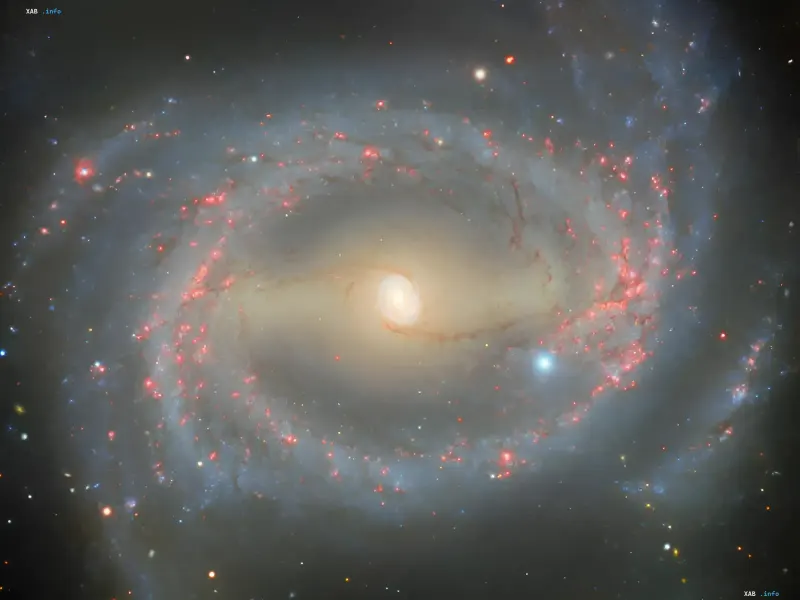
A supernova explosion, designated SN 2026ahvu, has been recorded in the galaxy NGC 1433, located approximately 50 million light-years from Earth. The discovery was made on November 2, 2026, by ATLAS (Asteroid Terrestrial-impact Last Alert System), a network of telescopes originally designed to search for asteroids and potentially hazardous near-Earth objects. Crucially, the outburst was captured before it reached maximum brightness: projections indicate that the peak glow will occur between November 18 and November 23, 2026. The detection and classification of the object have been confirmed by the Transient Name Server (TNS) catalog, where the supernova was logged on November 2 and classified as Type Ia.
Explosion Physics: A White Dwarf on the Brink
SN 2026ahvu belongs to Type Ia supernovae—a class of explosions involving white dwarfs, which are extremely dense remnants of Sun-like stars that have exhausted their thermonuclear fuel. In one of the primary scenarios, a white dwarf in a binary system gradually accretes material from a companion star. As its mass accumulates, a thermonuclear explosion is triggered, destroying the star. For the classic scenario, the critical threshold is approximately 1.44 solar masses—the Chandrasekhar limit, upon reaching which the white dwarf loses its stability.
"Standard Candles" for Measuring the Universe
Type Ia supernovae hold special significance in cosmology due to their predictable maximum luminosity. They are used as "standard candles"—objects with known brightness characteristics that allow astronomers to determine distances to distant galaxies. The more accurately astronomers understand the physics of such explosions and their evolving brightness over time, the more reliable cosmic distance measurements become. This is precisely why every new Type Ia supernova that can be tracked from its early phase to its peak is of great interest for refining cosmological models.
NOIRLab Observations and Call to Observatories
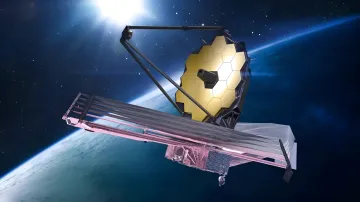
SN 2026ahvu is already being monitored by the U.S. National Science Foundation (NSF) through its NSF NOIRLab (National Optical-Infrared Astronomy Research Laboratory). Observations are currently utilizing the Dark Energy Camera (DECam) mounted on the Víctor M. Blanco Telescope in Chile, as well as the Gemini South telescope. NOIRLab has also issued a call for other ground-based and space observatories to join the monitoring campaign. Scientists need detailed data on the supernova's changing brightness and its emission across various electromagnetic spectrum bands, especially beyond visible light—such observations will help refine Type Ia supernova models, which are vital for modern cosmological research.
Is the Outburst Visible to Amateurs and From Where?
Amateur astronomers are also invited to join the observations: the supernova is already bright enough to be spotted with a small telescope, and its brightness is expected to increase several times over by its peak. However, there is a geographical constraint: the galaxy NGC 1433 is located in the constellation Horologium (the Clock), which is well-suited for viewing from the Southern Hemisphere. In the Northern Hemisphere, this constellation rises only a few degrees above the horizon, making observations from there significantly more challenging. Nevertheless, for southern latitudes, this is a rare opportunity to track the evolution of a Type Ia supernova in real time—from its early phase to the peak predicted to arrive in the coming days.