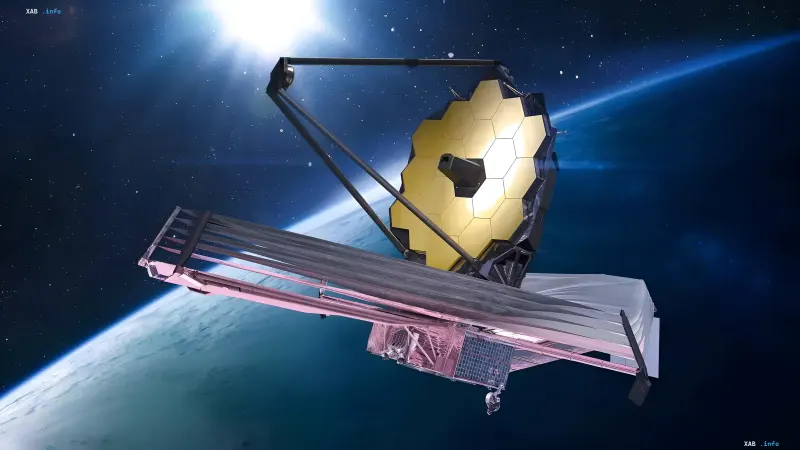
Astronomers have introduced a computational method called FLIP (Physics-based Learning for Imaging Planets), which has made it possible to create an accurate digital twin of the James Webb Space Telescope and re-process its archival images. As a result, scientists isolated the signal of the gas exoplanet 51 Eridani b at a wavelength of 4.3 µm — a range where the planet had previously failed to appear under any standard processing method. According to the developers, this is the history's first direct detection of an exoplanet at this specific wavelength, opening up new opportunities for studying the atmospheric compositions of distant worlds.
The Problem That Blocked Direct Observation for Decades
The main obstacle to direct imaging of exoplanets is the colossal brightness contrast between a planet and its star. In typical systems, a planet can be a million times dimmer than its parent star, and even tiny changes in the position or tilt of the telescope's optical elements — down to a few nanometers — drastically alter the pattern of stray light on the detector. Standard methods for combating this glare rely on reference images of the star taken in adjacent frames, but they fail to account for microscopic deviations in the optical layout, leaving the faint planetary signal "hidden" in the residual noise.
How FLIP Models Physics Rather Than Just Subtracting Noise
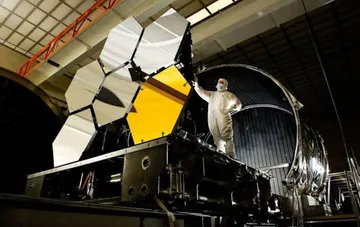
Unlike traditional approaches, FLIP does not use ready-made reference images of the star. The algorithm builds a physical model of how light passes through the telescope's mirrors and hits the detectors, and then adjusts the parameters of the virtual model so that it reproduces actual observations while accounting for the tiniest deviations of the optical system. After calibration, the calculated stellar glare pattern can be subtracted from the original image while preserving the weaker planetary signal. The developers separately verified that the algorithm does not remove genuine planetary radiation along with the glare: artificial planetary signals were added to the raw data and checked to see if the program recovered them after processing.
Testing on Two Known Systems
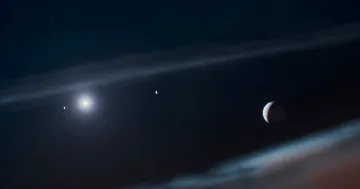
The method was tested on archival observations of two stellar systems with already known exoplanets — HIP 65426 and 51 Eridani. During testing, FLIP demonstrated a sensitivity to weak planetary signals 2 to 15 times higher than standard processing methods. The most telling result was obtained when analyzing the 51 Eridani system: the planet 51 Eridani b was first discovered in 2015 using ground-based telescopes and is a young gas giant comparable in size to Jupiter. James Webb observed this system at a wavelength of 4.3 µm — a range where astronomers study carbon dioxide in planetary atmospheres — yet standard processing failed to reveal the signal of 51 Eridani b. After applying FLIP, the planet became visible right where its position was expected, and the sensitivity to its signal increased fourfold.
Re-analyzing the Archive and Plans for Future Observatories
Since FLIP works with previously acquired images, the team intends to use it to re-analyze the entire James Webb archive in search of exoplanets that went unnoticed during initial processing. The method is not tied exclusively to the design of this telescope: the developers plan to adapt it for the Nancy Grace Roman Space Telescope and a number of ground-based observatories. Another promising direction is NASA's future Habitable Worlds Observatory project, designed for the direct observation of Earth-like planets around Sun-like stars. Such planets can be roughly 10 billion times dimmer than their stars, and without physical modeling of the optical system, their detection would be practically impossible.