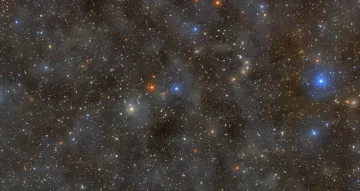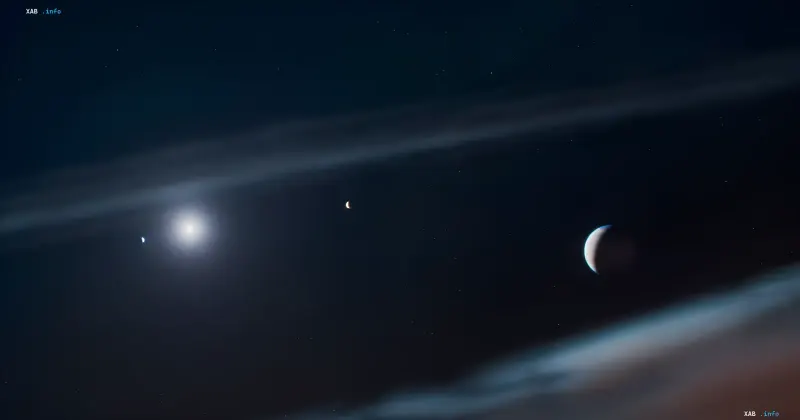
An international research team, including scientists from Harvard University, has reported a groundbreaking breakthrough in astronomy. For the first time in history, scientists have directly detected radio signals originating not from a star, but directly from an exoplanet. The object of study was the gas giant Beta Pictoris b, located approximately 63 light-years from Earth.
Discovery Method and Object Characteristics
To monitor space, the research team used the powerful MeerKAT radio telescope array consisting of 64 antennas located in South Africa. Beta Pictoris b is a massive gas giant with a mass roughly 12 times that of Jupiter. The planet orbits a young variable star and has been under close observation by astrophysicists due to its active dynamics.
The recorded repeating radio waves are believed by researchers to be analogous to auroras well known from the gas giants of our Solar System, such as Jupiter and Saturn. Such emissions occur as a result of charged particles interacting with the planet's powerful magnetic field.
Record Magnetic Field Strength
Preliminary deep analysis of the data exceeded the scientific community's boldest expectations. It turned out that the magnetic field of exoplanet Beta Pictoris b is at least 200 times more powerful than Jupiter's magnetic field. These figures significantly exceed the theoretical models and predictions previously made by scientists for exoplanets of this class.
This discovery proves that studying exoplanet radio emissions can become a key tool for understanding the internal structure of distant worlds, their evolution, and the nature of their interaction with parent stars.
Prospects for Further Research
Despite the high reliability of the recorded signals, the scientific team plans to continue a series of observations using ground-based and space observatories. Scientists must carefully verify the obtained data, exclude possible side interference, and try to explain the causes of such an anomalously strong magnetic field in the young exoplanet.