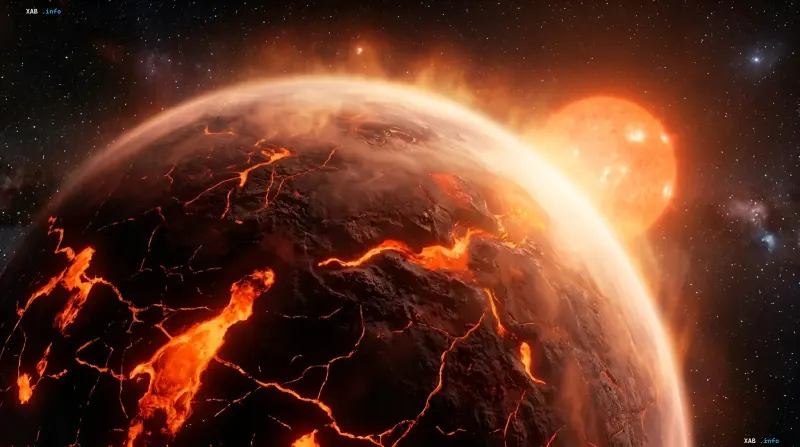
An international team of astronomers led by specialists from the University of Chicago has made a significant discovery, detecting signs of an atmosphere on the scorching rocky exoplanet HD 3167 b. This cosmic object is located approximately 154 light-years from Earth and completes a full orbit around its host star in just one Earth day. Such unique characteristics make the planet a focus of intense interest for the scientific community aiming to understand the evolutionary processes of rocky worlds.
Characteristics of the 'Lava World' and the James Webb Telescope
The study was conducted using the capabilities of the modern James Webb Space Telescope, with the results published in the prestigious Astrophysical Journal Letters. The object HD 3167 b belongs to the class of so-called lava worlds—rocky planets situated so close to their stars that temperatures on their surfaces can melt rocks. Furthermore, the side of the planet facing the star is most likely a continuous ocean of liquid magma boiling under intense radiation.
Secondary Eclipse Method and Temperature Anomalies
Scientists did not observe the gaseous envelope directly, but identified its presence using the secondary eclipse method, capturing the moment when the planet hides behind its star. The James Webb telescope measured infrared radiation fluctuations of the system before and during the eclipse, allowing for a precise estimation of the exoplanet's thermal emission. It turned out that the daytime side of HD 3167 b was noticeably cooler than theoretical calculations for an airless body. The primary explanation for this phenomenon is precisely the atmosphere, which efficiently redistributes heat to the nightside, along with the presence of reflective clouds.
Contradictory Data
During the analysis of the obtained data, researchers encountered certain discrepancies regarding the exact chemical composition of the gaseous envelope. Initial hypotheses were built on the assumption that evaporated rock vapors and silicates predominated due to extreme temperatures. However, recent measurements allow for the presence of heavier molecular compounds, including carbon dioxide, carbon monoxide, and water vapor, which requires additional spectral observations for final confirmation.
Significance of the Discovery for Science
The findings are of fundamental importance for understanding the early history of our own Solar System. In the first millions of years of its existence, Earth was also a molten global magma ocean driven by constant cosmic bombardments. Studying the atmospheres of lava super-Earths opens new horizons for astrophysics and helps model scenarios for the formation and preservation of gaseous envelopes on young rocky planets in our galaxy.