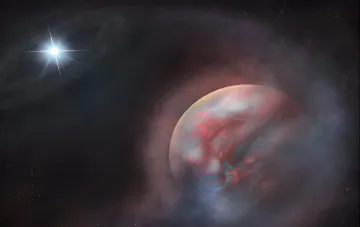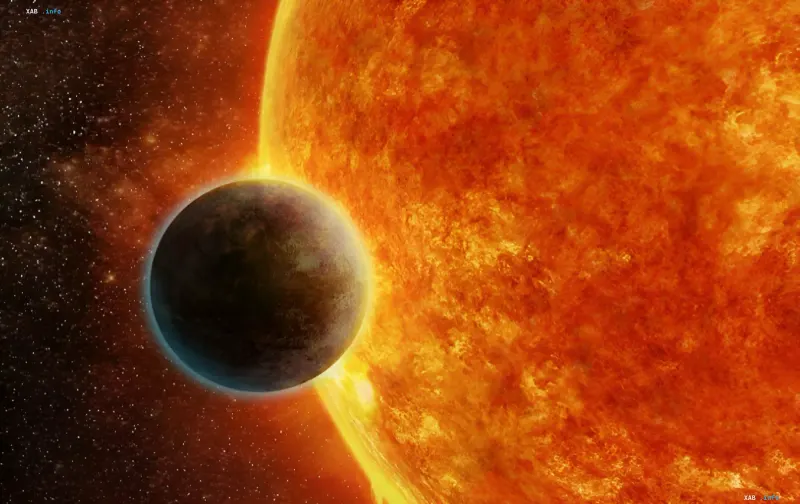
Astronomers have recorded probable traces of helium leaking from the atmosphere of exoplanet LHS 1140b, located in the habitable zone of a distant star system. A new study published in the professional scientific journal Science opens fundamentally new horizons in the search for signs of extraterrestrial life and the study of potentially habitable worlds beyond the Solar System. Previous observations using the James Webb Space Telescope reliably ruled out the presence of a hydrogen-rich primordial atmosphere, which typically forms alongside young planets and quickly dissipates into open space.
Characteristics and Uniqueness of the Sub-Neptune World
The enigmatic exoplanet LHS 1140b is approximately 1.7 times larger than Earth, with a mass just over 5 times that of our planet. This cosmic object orbits a dim star that is roughly 300 times fainter than our Sun, completing a full orbit in just 24.7 Earth days. In modern astronomy, such sub-Neptune worlds spark fierce debates among researchers because our Solar System lacks direct analogs for these planets, even though they have turned out to be the most common type of objects in our galaxy.
The Search for a Secondary Atmosphere and Chemical Composition
The detection of helium leakage strongly suggests the presence of a secondary atmosphere—a more stable, dense, and long-lasting envelope. On our native Earth, a similar secondary envelope has existed for billions of years, and its unique chemical composition is sustained by the constant complex interaction of geology, chemical processes, and biological life. Discovering such markers on rocky planets helps scientists model possible scenarios for the emergence of life in other star systems.
Contradictory Data on Temperature Conditions
Contradictory data surround the surface temperature conditions on LHS 1140b, upon which the existence of liquid water directly depends. If the planet absorbs all stellar radiation, its average temperature without accounting for the greenhouse effect would be around -30 °C, leaving a realistic chance for warmth and liquid oceans if greenhouse warming is present. However, more sophisticated mathematical models demonstrate that the actual surface temperature could drop to an extreme -90 °C, turning the world into a cold analogue of modern Mars.
Prospects for Further Research
This result marks only the second confirmed case in astronomical history where scientists have captured a clear hint of an atmosphere around a potentially rocky planet (the first being Gliese 1214b). Nevertheless, leading experts emphasize that these studies are only in their initial stages, and to draw definitive conclusions about the potential existence of extraterrestrial life, humanity will need to study thousands of similar atmospheres deep in space.