The James Webb Space Telescope has completed a detailed study of two stars previously considered potential candidates for Dyson spheres — giant hypothetical megastructures built to harvest stellar energy. The observations have completely refuted the hypothesis of extraterrestrial technology, explaining the detected anomalous thermal trail through natural astronomical factors.
The Dyson Sphere Concept and the Hephaistos Project
The theory of giant energy structures was proposed by American physicist Freeman Dyson back in 1960. According to the laws of thermodynamics, any highly advanced civilization creating structures to absorb starlight must inevitably re-emit residual energy in the form of characteristic infrared radiation.
As part of the large-scale Hephaistos project, a team of researchers from Uppsala University in Sweden analyzed archival data covering nearly five million stars in the Milky Way. The scientists managed to identify several dozen objects with a suspicious excess of mid-infrared spectrum, among which candidates D and E stood out as the most promising targets for further investigation.
Results of the Orbital Observatory's Spectral Analysis
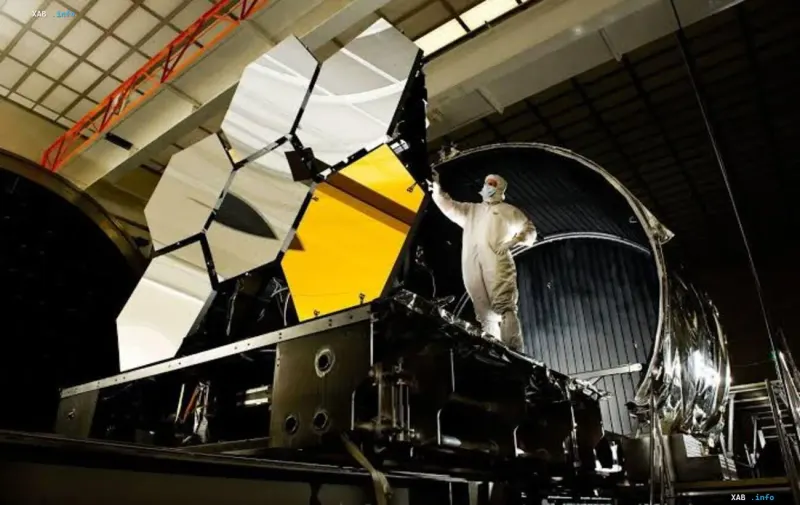
To test the hypothesis, astronomers utilized the capabilities of the James Webb Space Observatory, which is capable of capturing the finest nuances of the infrared spectrum. The obtained data showed that the sources of anomalous heat are not alien megastructures, but distant background galaxies that happened to lie along the line of sight directly behind the studied stars.
Specifically, candidate D turned out to be a distant galaxy whose thermal excess is caused by warmed dust clouds surrounding a supermassive black hole. Candidate E represents a background galaxy with an extremely high rate of star formation, whose spectral characteristics precisely imitated the emission of hypothetical Dyson spheres.
Significance of the Discovery for Future Searches
Although no signs of extraterrestrial civilizations were found, scientists regard the results as a major technological and scientific success. The acquired experience made it possible to refine unique algorithms for separating superimposed light sources and filtering out natural galactic noise.
The developed methodologies will serve as a reliable foundation for future astronomical sky surveys using the James Webb telescope and subsequent space missions. This will allow researchers to more effectively weed out false signals when searching for traces of genuinely technologically advanced civilizations in the universe.