In October 2026, the advancement of space technologies continues to turn science fiction ideas into real engineering projects, opening up prospects for interstellar flights without traditional fuel. The concept of using light pressure, first proposed in the works of James Clerk Maxwell and popularized by Arthur C. Clarke, is finding practical application today in the development of laser nanoprobes and solar sails. These devices are capable of reaching colossal speeds through light impulse, solving the fundamental problem of bulky rocket engines.
Scientific Origins and Early Prototypes
The term "solar sail" became established in the late 1950s thanks to the science fiction works of Arthur C. Clarke, whose technological predictions have repeatedly been confirmed over time. The foundation of this technology lies in the physics of light, which can transfer momentum to a reflecting surface. An important step toward the practical mastery of this concept was the launch in 2010 of the Japanese spacecraft IKAROS, which successfully demonstrated the operation of a solar sail in the real conditions of open space.
The Breakthrough Starshot Project and Nanophotonic Sails
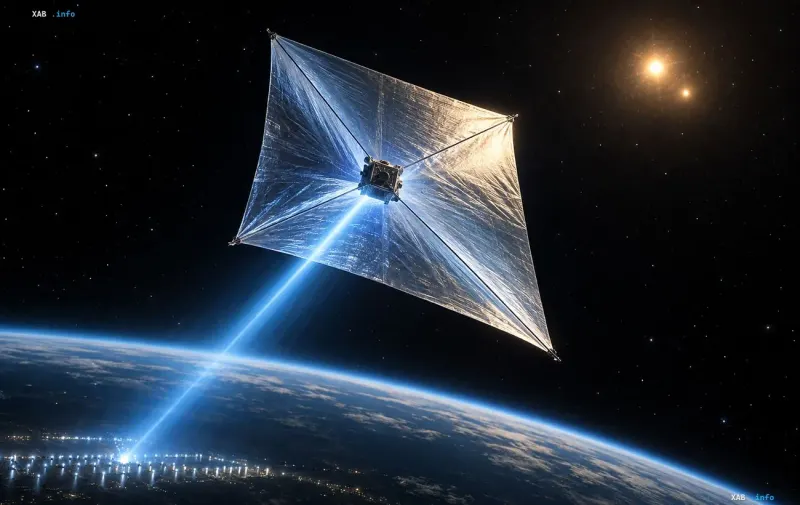
To overcome interstellar distances to nearby systems such as Alpha Centauri, classic chemical-fuel rockets prove ineffective due to enormous mass and insufficient speed. In 2016, billionaire Yuri Milner, with the support of physicist Stephen Hawking, initiated the Breakthrough Starshot program. The project aims to create ultralight nanophotonic sails weighing a few grams, which will be accelerated by a powerful array of ground-based lasers to a speed constituting a significant fraction of the speed of light.
Miniaturization of Technologies and Modern Tasks
The development of microelectronics and modern smartphone components has allowed engineers to create ultra-compact sensors and cameras the size of a millimeter, known as "smart dust." Such devices do not require heavy power systems or onboard fuel reserves, opening up opportunities for unconventional maneuvers, exploration of near-polar orbits, and comets. Upcoming space missions utilizing sails aim for a detailed study of distant exoplanets, including potentially habitable worlds like LHS 1140 b.
Prospects for Interstellar Research
The transition to laser and solar sails marks a qualitative shift in space exploration, taking humanity beyond the Solar System. In the foreseeable future, the successful implementation of such projects will allow direct imaging of exoplanets and the collection of scientific data from other stellar systems. This turns the concept of interstellar travel from the realm of theoretical physics into a tangible reality of the 21st century.