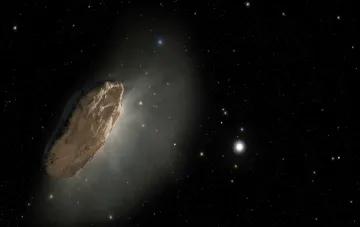
In April 2029, the large asteroid Apophis will make an unprecedentedly close pass by Earth, coming within about 32,000 kilometers of our planet. Although there is no direct threat of a collision with Earth, the planet's powerful gravitational field will trigger massive tidal effects. These forces have the potential to significantly transform the celestial body's structure, altering its shape, rotation speed, and orbit.
Tidal Forces and Internal Structure of the Asteroid
The 400-meter-wide space rock will experience intense gravitational influence from Earth during its close flyby. This gravitational pull will begin to twist and stretch Apophis, provoking internal fractures and micro-shifts on its surface. Researchers note that such a shaking acts as a unique natural tool, exposing internal structures normally hidden beneath the surface layer of the space rock.
Scientists emphasize the uniqueness of the upcoming event, comparing it to breaking a piñata where hidden elements spill out. Although similar processes have been observed when comets pass close to the Sun, observing such mechanics on a large asteroid is extremely rare. This will provide astronomers with an unprecedented opportunity to obtain detailed data on the actual composition and structure of such objects.
Near-Earth Orbit and Satellite Threat
In addition to structural changes in the asteroid itself, specialists have carefully calculated the risks of its potential interaction with artificial objects in near-Earth orbit. At an altitude of about 36,000 kilometers, geostationary communication and meteorological satellites are concentrated, along with a significant amount of uncontrolled space debris. There are about 600 active devices operating in this region.
However, mathematical modeling has shown that the probability of Apophis colliding with operating spacecraft or debris is extremely low. At the same time, a theoretical accident of this kind could unpredictably adjust the asteroid's trajectory, which required additional calculations from ballistics experts and relevant agencies.
Space Agency Preparations and the Ramses Mission
The upcoming close approach has attracted the close attention of the global scientific community and leading space agencies. Specifically, the European Space Agency has approved and is actively preparing a dedicated mission called Ramses. The launch of this research spacecraft is scheduled for April 2028 so that it can arrive at the asteroid and accompany it during the flyby.
The main goal of the upcoming expeditions will be to thoroughly document and measure the consequences of Earth's gravitational impact on the asteroid. The data obtained during the mission will make a critically important contribution to the development of planetary defense systems and help better predict the behavior of similar near-Earth objects in the future.