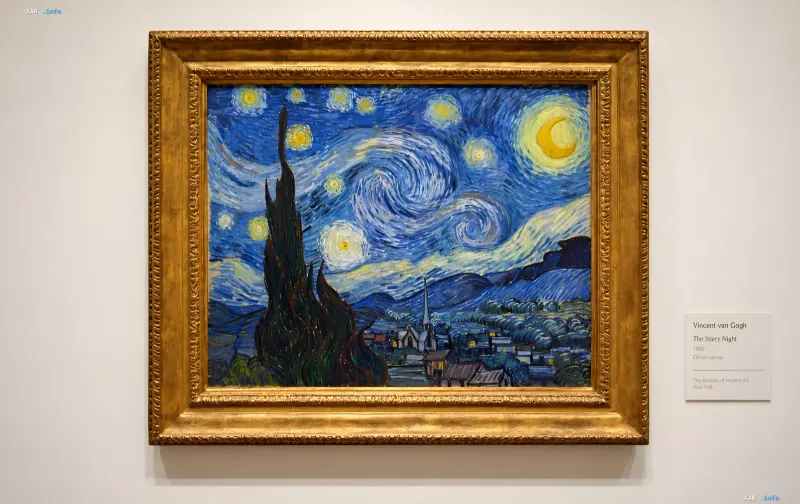
One of the most famous paintings in art history — Vincent van Gogh's 'The Starry Night' — can now be dated more precisely than art historians have assumed for over a century. A South Korean research team led by Kim Jung-hyun published a study in Scientific Reports (2026) comparing the astronomical analysis of the sky on the canvas with the actual positions of celestial bodies over Saint-Rémy-de-Provence. The study's conclusion: the painting corresponds to the state of the pre-dawn sky on July 22, 1889, which is a full month later than the generally accepted date of June 1889. This was reported by RBC-Ukraine with reference to the publication.
How Astronomers 'Dated' the Canvas
The research methodology was built on direct comparison: the team extracted astronomical objects from the composition — stars, a crescent moon, planetary and star clusters — and checked at what moment they could simultaneously occupy the positions depicted in the painting in the sky over Saint-Rémy-de-Provence, France. This approach allows a shift from stylistic and archival hypotheses to verifiable astronomical constraints: the positions of luminaries on a specific date and time are not subject to arbitrary interpretation. According to the scientists, it is precisely around July 22, 1889, before dawn, that an exact match of all celestial bodies shown on the canvas is achieved.
Why June Does Not Add Up
For many years, art historians held the version that Van Gogh painted 'The Starry Night' immediately after arriving at the asylum for the mentally ill in June 1889 — where he entered following the severed ear incident. However, astronomical verification revealed a discrepancy: in mid-June, the Moon did not have the shape of the precise crescent depicted on the canvas. The shape of the lunar crescent in the painting, according to the researchers' calculations, completely matches the actual appearance of the Moon only on the morning of July 22, which became the key argument for shifting the date.
July 22: Alignment of Sky and Weather Conditions
In addition to the Moon, the Hyades star cluster in the constellation Taurus was emerging in the eastern part of the sky near Venus during that period — an object also present in the composition. The scientists additionally checked the meteorological situation: on July 22, 1889, weather conditions provided clear skies suitable for observations, which is consistent with the clear, meticulously detailed celestial scene of the painting. The combination of these factors — the shape of the crescent, the position of Venus and the Hyades, atmospheric transparency — creates a unified, internally consistent image that is difficult to replicate for other dates.
Correspondence as Additional Proof
The researchers cross-referenced the astronomical data with archival sources — Van Gogh's correspondence with his brother. The letters from that period contain mentions of cicadas in the leaves, which, according to the team's assessment, points to a hotter July rather than June. This evidence, independent of astronomy, reinforces the dating: biological and climate details from the correspondence match the time window identified by the positions of celestial bodies.
What This Changes in the Understanding of Van Gogh
Importantly, the new dating does not question the artist's creative method. The researchers acknowledge that Van Gogh worked in the studio based on sketches and memory, combining observations made on different nights. Nevertheless, as emphasized in the work, the analysis proves that the artist closely observed the real night sky rather than inventing its details from imagination. Thus, 'The Starry Night' appears not merely as a product of fantasy, but as the result of careful, albeit undocumented in the moment, astronomical observation — making the revision of the painting's creation date significant for both art history and the science of the skies.