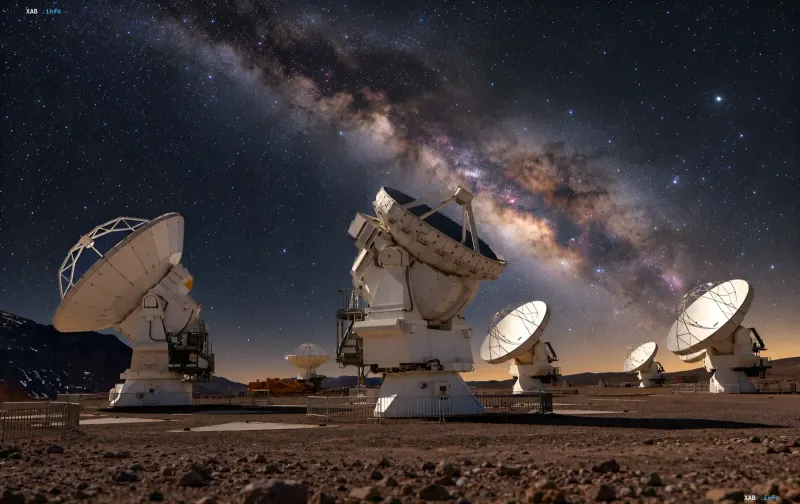
Astronomers have recorded unexpected chemical anomalies in the gas and dust disks surrounding young stars where planetary systems are forming. Observations made using the Atacama Large Millimeter/submillimeter Array (ALMA) radio telescope shed light on how methanol distribution affects the formation of new planets and the emergence of habitable conditions. The study's findings, published in the scientific journal Astronomy & Astrophysics, were relayed to the media by RBC-Ukraine and represent the first detailed data from the COMPASS (Complex Organic Molecules in Protostars with ALMA Spectral Surveys) project.
Methanol as a Key Molecule for Life's Origins
Methanol is the most abundant complex organic molecule in protoplanetary disks, making it a central focus in the study of the origins of life. Consequently, its chemical behavior in young stellar systems interests researchers: how this molecule is distributed and transformed largely determines the composition of the material from which planets eventually coalesce. An international team of over 30 scientists led by Maria Drozdovskaya of the University of Bern focused on the gas disks around 11 nearest low-mass protostars to trace these processes in detail.
Deuterium Anomaly in the Disk of Star IRAS 4A2
During the observations, the researchers discovered a rare form of methanol in which ordinary hydrogen atoms are replaced by its heavy isotope, deuterium. Such an anomaly was recorded in only one of the 11 objects studied—in the disk of the young star IRAS 4A2, located about 1,000 light-years from Earth in the Perseus molecular cloud. The presence of this isotopic composition in a single instance indicates that the chemical evolution of disks is not universal and can vary greatly from system to system.
Maser Emission in Low-Mass Stars
In addition to the rare isotope, the COMPASS team detected methanol maser emission in more than 50 percent of the surveyed protostars, predominantly in the youngest systems. A maser is the microwave equivalent of a laser, where radiation is naturally stimulated and amplified during collisions and excitation of methanol molecules in shock waves. Previously, such powerful radio signals were detected only near massive stars. Their discovery in smaller and calmer stars indicates the presence of unusually high-energy regions in these systems and may mean that such signals arise during planet formation around stars of varying masses, not just the most massive ones.
Chemical Diversity and the Role of Shock Waves
Scientists suggest that when a young star accretes gas from its surrounding disk, it periodically heats up and generates shock waves. According to the researchers, these waves can activate methanol in the gas and cause it to emit powerful radio signals—masers. Furthermore, the team identified differences in oxygen and nitrogen content across various stellar systems. This means that the chemical composition of the material from which planets form can differ significantly from system to system, an important factor to consider when modeling the conditions for life to arise on other worlds.
Initial Publications and Upcoming James Webb Observations
The first detailed results of the COMPASS project were published in seven papers in the scientific journal Astronomy & Astrophysics in October 2026. Astronomers are continuing the systematic analysis of data collected by the ALMA telescope and are preparing a series of follow-up observations using the James Webb Space Telescope, which will complement radio data with infrared measurements and refine the picture of protoplanetary disk chemical evolution.