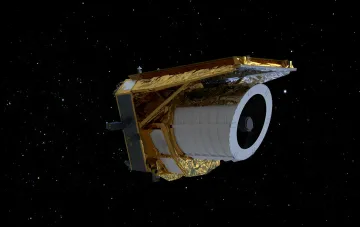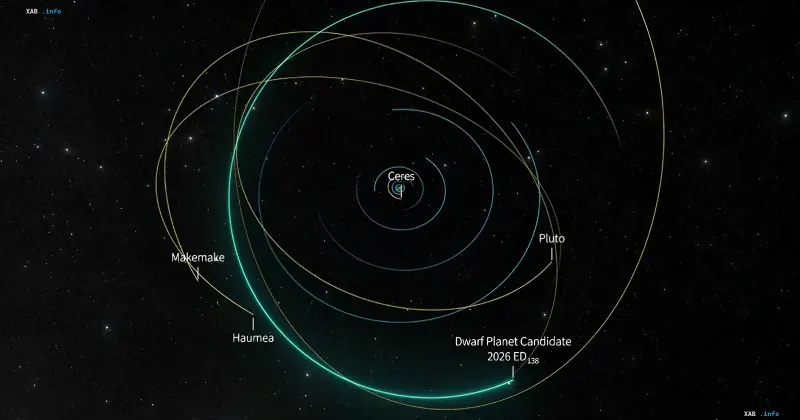
The Vera C. Rubin Observatory in Chile has unveiled its initial findings, including a celestial body temporarily designated as 2026 ED138, which scientists are considering as a dwarf planet candidate. According to data reported by Phys.org on October 28, the object is located nearly 7 billion kilometers from the Sun, far beyond the orbit of Pluto. Mario Juric, head of the observatory's Solar System research division, speaking on the sidelines of the International Astronomical Union event in Spokane, Washington, on October 27, called the discovery a potential start to a series of findings: "I hope this is just the first of many future discoveries."
An observatory continuously scanning the night sky
The Vera C. Rubin Observatory is being implemented by the U.S. National Science Foundation in collaboration with the Department of Energy and is located on a mountaintop in Chile. Its telescope continuously scans the night sky, and in a short time, the project has detected about 2,300 celestial objects located beyond Pluto's orbit. Among all the identified bodies, 2026 ED138 stands out as the largest in size, making it the primary candidate for dwarf planet status in the observatory's current list of findings.
Size estimates: from 600 to 1,545 kilometers
The exact diameter of the new object remains unknown as it depends on its albedo — the surface's reflectivity. Based on brightness, distance, and other factors, astronomers provide an approximate estimate: if the surface of 2026 ED138 is relatively bright and reflective, its cross-section could be around 600 km; if the surface is dark, the diameter could reach 1,545 km. Both scenarios place the object within a range that scientists consider sufficient for forming a spherical shape.
Criteria of the International Astronomical Union
According to the IAU definition, a dwarf planet must be massive enough for its own gravity to give it a near-spherical shape. For icy objects on the outskirts of the Solar System, scientists believe this condition is most likely met by bodies with a diameter exceeding 400 km. Thus, even the lower bound of the 2026 ED138 size estimate exceeds this threshold, justifying its candidate status. Final recognition, however, will require additional observations and a formal IAU decision.
Twenty years without new dwarf planets
The context of the discovery is significant: in 2006, the International Astronomical Union removed Pluto from the list of planets and reclassified it as a dwarf planet, recognizing a total of five such bodies — Ceres, Pluto, Eris, Haumea, and Makemake. Since then, the IAU has not added any new objects to this list, and 2026 ED138 could become the first candidate capable of expanding the list after twenty years. For now, it is a candidate, not a finalized recognition, so the object's status remains preliminary.