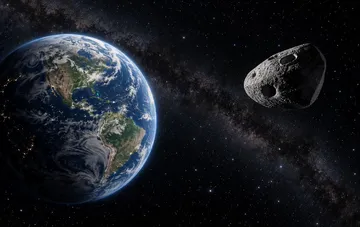
For decades, asteroid 1998 KY26 has remained one of the most enigmatic small bodies in the Solar System: its trajectory has exhibited a persistent anomalous acceleration that defied standard models of space object motion. The most popular explanation for this oddity was the hypothesis that the object is actually a “dark comet” — a body covertly outgassing and receiving additional jet propulsion. However, a new study published in the scientific journal Icarus casts serious doubt on this version, effectively ruling it out in a series of calculations.
Anomalous Acceleration That Defies Models
Most asteroids in interplanetary space move predictably: their trajectories are shaped by the gravity of the Sun and planets, as well as solar radiation pressure. The 11-meter object 1998 KY26 behaves differently — it accelerates as if it has its own “engine,” which contradicts astronomers' expectations for ordinary rocky bodies. It is precisely this discrepancy between calculated and observed dynamics that has made the object a subject of intense researcher scrutiny.
Why the “Dark Comet” Hypothesis Was So Popular
The key difference between asteroids and comets lies in their composition. Asteroids are predominantly rocky, whereas comets contain significant amounts of ice. Upon sublimation, ice turns into gas and blasts out into space, creating jet propulsion that additionally pushes the comet along its orbit. Hence the logical assumption: if 1998 KY26 accelerates “like a comet,” perhaps it is a comet, simply without a visible tail — a “dark” one whose faint outgassing is not directly detected.
Thermal Modeling Debunks the Presence of Ice
Aerospace engineers Corbin Hansen and Masatoshi Hirabayashi from the Georgia Institute of Technology tested this hypothesis using detailed mathematical modeling, combining data on the object's size, orbit, reflectivity, and potential composition to calculate temperatures on its surface and deep interior. The conclusion was unambiguous: for water ice to persist for a long time, the body's temperature must steadily remain below 145 kelvins (about −128 °C). However, even in the coldest regions of 1998 KY26, the average temperature over the orbital period is at least 212 kelvins (about −61 °C). Under such conditions, any ice would have evaporated within a matter of years, and even if it were providing the current acceleration, the entire supply would have been depleted in about 62 years. These calculations virtually completely rule out the presence of internal ice and, consequently, the object's status as a “dark comet.”
Solar Radiation Pressure is the New Prime Candidate
If gas outgassing is impossible due to excessively high temperatures, researchers turn to alternative explanations. The most likely factor remains solar radiation pressure. According to the authors, sunlight can exert a steady pressure that over time forms noticeable acceleration for such tiny objects. This interpretation is consistent with the fact that the effect accumulates gradually and does not require volatile substances in the asteroid's body.
Hayabusa2 to Arrive at the Object in July 2031
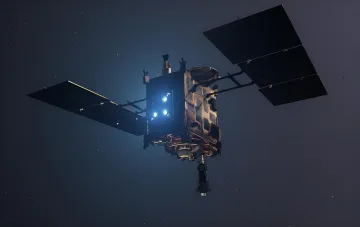
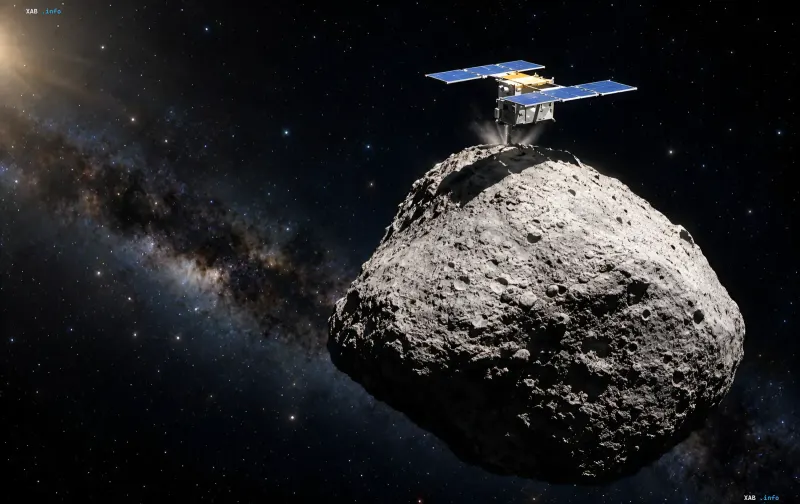
Direct observation will finally resolve the intrigue. The Japanese spacecraft Hayabusa2, developed under a mission by the Japan Aerospace Exploration Agency (JAXA), is scheduled to arrive at 1998 KY26 in July 2031. Direct study of the composition and structure of the unusual celestial body will provide data that no modeling can give, and will finally determine the nature of the anomalous acceleration of this mysterious object.