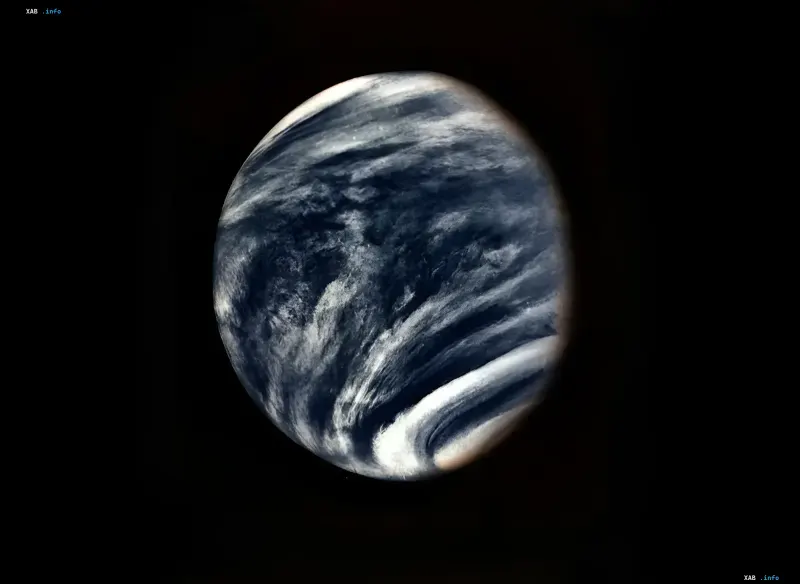
Scientists have finally unlocked the mystery behind the persistent haze in Venus's atmosphere, which was initially detected by space probes back in the 1970s. For decades, the exact origin of this atmospheric phenomenon remained a puzzle, generating numerous scientific hypotheses and intense academic debates.
Cosmic Dust as the Source of Fog
As discovered by a research team led by planetary scientist Hiroki Karyu from Tohoku University, the key driver of this haze is the continuous influx of cosmic dust particles from meteors burning up in the Venusian atmosphere. These microscopic particles interact with sulfuric acid, creating a distinct fog and acting as effective condensation nuclei for cloud formation.
Refuting the Volcanic Hypothesis
Previously, the scientific community widely assumed that the haze formed from massive volcanic ash emissions, given Venus's high volcanic activity. However, detailed mathematical and microphysical modeling demonstrated that neither volcanic activity nor surface dust possesses the chemical properties required to form the observed atmospheric layer.
Ultraviolet Absorption and Iron Sulfate
The new research also sheds light on another long-standing Venusian enigma—the identity of the agent actively absorbing ultraviolet radiation. Researchers found that iron compounds, specifically iron sulfate detected by early Soviet and American probes, perfectly match the physical properties of the discovered cosmic haze.