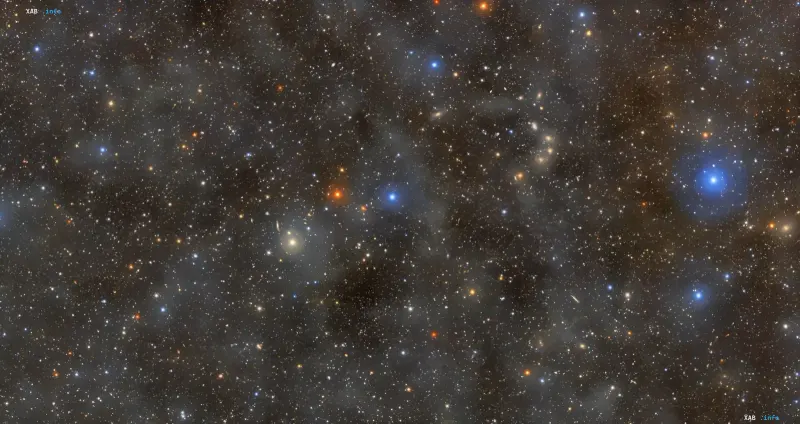
The Vera C. Rubin Observatory has made a remarkable scientific discovery even before the official launch of its large-scale ten-year sky survey. According to the latest astronomical data, the research team managed to discover an extremely faint dwarf satellite galaxy of our Milky Way, which was named Aquarius IV. This celestial object was found based on the analysis of test data arrays, highlighting the high efficiency of modern space observation tools even at the stage of their preliminary calibration and setup.
Test Survey Details and Search Methodology
The new space object was recorded within the Early Data Preview 2 (EDP2) test data, which was successfully collected between April 2025 and January 2026. This preliminary survey covered about 7 percent of the celestial sphere, providing the global scientific community with unique opportunities to test search algorithms for future large-scale studies. Scientists searched for stellar groups that strictly correspond to a single isochrone—a curve clearly showing the relationship between the color and brightness of stars formed simultaneously from the same gas cloud.
Significance of the Discovery for Dark Matter Research
The complex population model of ancient and extremely metal-poor stars was thoroughly tested at various distances, resulting in the detection of significantly more corresponding luminaries in the Aquarius IV region than expected from random background indicators. The obtained characteristics convincingly indicate that the object is indeed an extremely faint dwarf galaxy. Such cosmic structures are of colossal interest to modern astrophysics and cosmology in the context of studying the nature of dark matter, since such miniature galaxies contain record-low amounts of ordinary baryonic matter, and their general properties are determined predominantly by massive dark halos.
Prospects for Future LSST Observations
Currently, astronomers reliably know of about 40 such dwarf satellite galaxies around our Milky Way. According to expert assessments by specialized professionals, the upcoming full-scale LSST survey will at least double this figure, opening new horizons for understanding the structure of the Local Group of galaxies. Recall that the main ten-year scientific operations of the Vera C. Rubin Observatory officially started in June 2026, and over the coming years, this advanced telescope will regularly and in detail observe the entire southern sky.