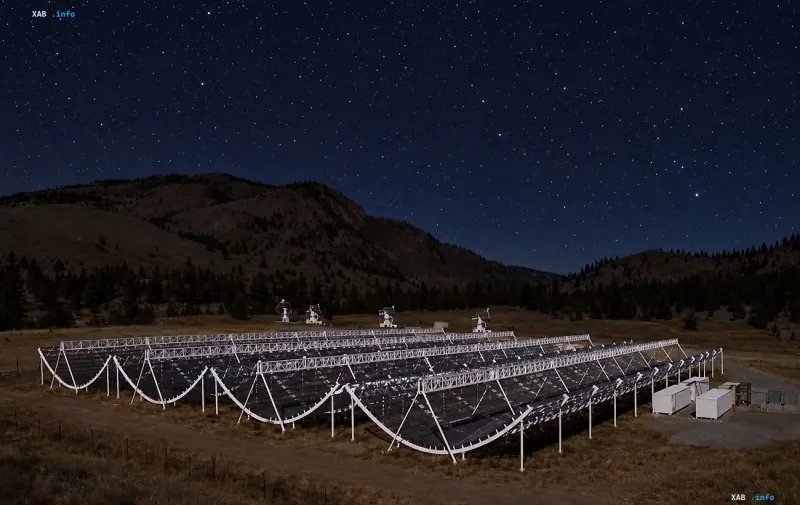
The Canadian CHIME radio telescope has learned to detect weak hydrogen radio signals from the early universe, which could make dark energy research significantly faster and cheaper. This is reported by RBC-Ukraine with reference to a study published in the professional journal The Astrophysical Journal. The new technique opens up prospects for a deep understanding of cosmological processes without the need to involve expensive combined observatories.
The Role of Dark Energy in Cosmic Evolution
Scientists note that dark energy acts as the dominant element of the modern universe, accounting for approximately 68 percent of the total balance of matter and energy. This mysterious factor began to actively affect space immediately after the expansion following the Big Bang slowed down, forcing cosmic structures to fly apart with increasing acceleration. Researchers are considering various scenarios for the future evolution of the universe under the influence of dark energy, including the hypothetical Big Rip or Big Crunch if gravitational forces prevail again.
Hydrogen as a Cosmic Marker
Since hydrogen is the most abundant element in space and the main building block for stars, its weak radio emission acts as a key cosmic marker. This signal clearly demonstrates how matter is distributed in space at various stages of evolution. Previously, researchers could effectively map neutral hydrogen solely by combining data from the Canadian CHIME radio telescope with observations from other large facilities, which required millions of dollars in costs. Now, the scientific project has proven in practice its ability to record the distribution of hydrogen independently.
Observation Results and New Horizons
Using only a small part of the available dataset, namely 94 nights of observations starting from 2019, a team of astrophysicists recorded a hydrogen signal from an era when the universe was only about 5 billion years old. The obtained data confirmed that approximately two percent of hydrogen was in a neutral atomic form, which allows for a completely new assessment of the dynamics of galaxy formation. In the future, researchers plan to use the dataset accumulated over seven years to study in detail the period when only 3 billion years had passed since the Big Bang.