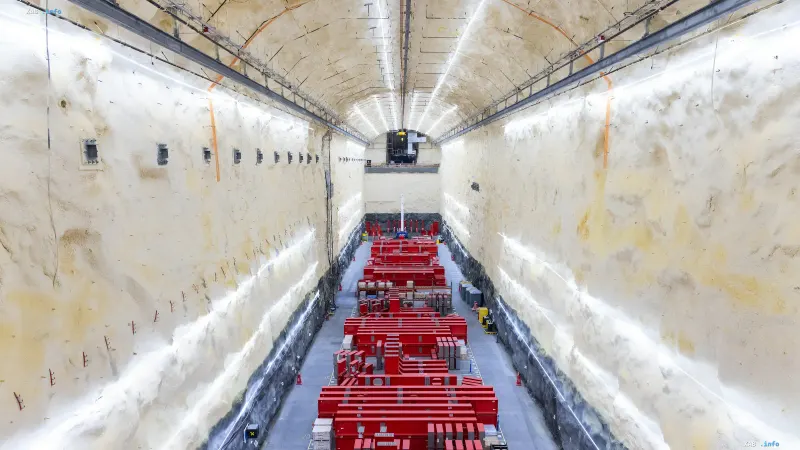
Nearly a kilometer underground in South Dakota, a construction crew comprising specialists from the European Organization for Nuclear Research (CERN), the U.S. Department of Energy's Fermi National Accelerator Laboratory (Fermilab), and the Sanford Underground Research Facility (SURF) has begun assembling giant cryostats — hermetic, thermally insulated vessels designed to store substances at ultra-low temperatures. These structures will serve as a key element of the Deep Underground Neutrino Experiment (DUNE). Steel assembly began in November, with over 2,600 red beams already transported down the shaft from the surface to a depth of 1,478 meters to form the structural framework of the vessels.
A Scale Surpassing a Boeing 747
Each of the future reservoirs will measure 65.8 meters long and 18.9 meters wide, holding approximately 17,000 tons of liquid argon, which will be cooled to −300 degrees Fahrenheit. In terms of dimensions, these structures exceed a Boeing 747 aircraft, and according to organizers, their height surpasses the famous Hollywood Sign. Such massive dimensions explain why the assembly is taking place inside a specially prepared underground complex rather than on the surface.
How the Experiment Will Work
The DUNE principle is based on sending a beam of neutrinos — electrically neutral subatomic particles capable of passing through matter with almost no interaction — through the Earth's crust over a distance of 1,300 kilometers from the Fermilab accelerator in Illinois to underground detectors. The first beam measurement is performed near the source, while a second detector records particle changes after their journey through the planet. Comparing these two measurements will allow scientists to study the fundamental properties of matter and search for answers regarding the violation of symmetry between matter and antimatter.
CERN's Role and the International Team
For the first time, CERN is undertaking such a massive role in a project outside of Europe, providing over 6,200 tons of steel and taking charge of the cryostats' design, logistics, and installation. The work is coordinated by an international team of 1,500 scientists uniting five U.S. Department of Energy laboratories alongside the European organization. This management structure highlights the transatlantic nature of the project and the division of engineering tasks among the world's leading accelerator centers.
Timeline Toward the Scientific Run
Completion of the underground complex preparation is scheduled for 2029, installation of the detector apparatus itself for 2030, and the launch of the main scientific run using the upgraded PIP-II accelerator — a Fermilab flagship upgrade project — is expected in 2031. The program is designed to run through the late 2040s, continuously recording neutrino fluxes from the sun, supernovae, and cosmic rays. The infrastructure being created will provide a permanent working environment for specialists and, according to the organizers, represents a long-term breakthrough in our understanding of the laws of nature.