Dark matter remains one of the greatest mysteries of modern physics. Despite making up the vast majority of the Universe's mass, humanity has yet to detect its direct presence. A new study published in the prestigious journal Physical Review D offers a radical explanation: the lack of signals lies not in the imperfection of instruments, but in the very geometry of space.
The Hidden Dimension Hypothesis
A team of astrophysicists led by Yu-Dai Tsai has put forward a bold theory. The scientists suggest that dark matter and the associated hypothetical particles — dark photons — exist in a hidden fifth spatial dimension. This concept builds on the ideas of Kaluza-Klein Theory from the 1920s, according to which additional dimensions are "curled up" on a microscopic level and remain invisible to human perception.
The key difference in the new model is access to this dimension. While ordinary matter is limited to four known dimensions (three spatial and time), dark particles have direct access to the fifth dimension.
Resonance Mechanism and 5D Geometry
The central element of the theory is the "dark matter resonance" mechanism. Physicists from Sheffield abandoned conventional approaches where the mass ratio of the dark photon and the dark matter particle was set arbitrarily. Instead, they derived these parameters directly from the geometry of the additional dimension.
According to calculations, in the early Universe, this resonance provided a strong interaction between ordinary and dark matter. However, as the cosmos expanded and cooled, this interaction weakened sharply. It is precisely this process that explains why modern ground-based detectors do not record direct signals from dark matter — it simply stopped actively "communicating" with our dimension.
Experimental Verification and Galactic Anomalies
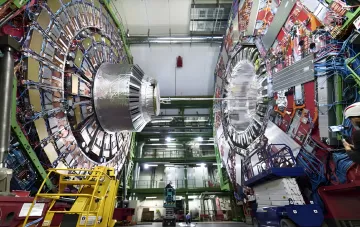
The theory does not remain merely a mathematical abstraction. Astrophysicists have already begun its experimental verification. The search for dark photons is underway within the NA64 experiment at CERN, as well as in alternative projects HeRALD and Oscura.
Furthermore, the 5D-resonance model offers a solution to another cosmological problem: it explains why there are fewer dwarf galaxies around the Milky Way and the Andromeda galaxy than predicted by the standard model.
Although proponents of Modified Newtonian Dynamics (MOND) attempt to explain such anomalies by changing the laws of gravity without introducing new particles, the latest data obtained by the Gaia space telescope and the Fermi satellite increasingly point in favor of dark matter models.