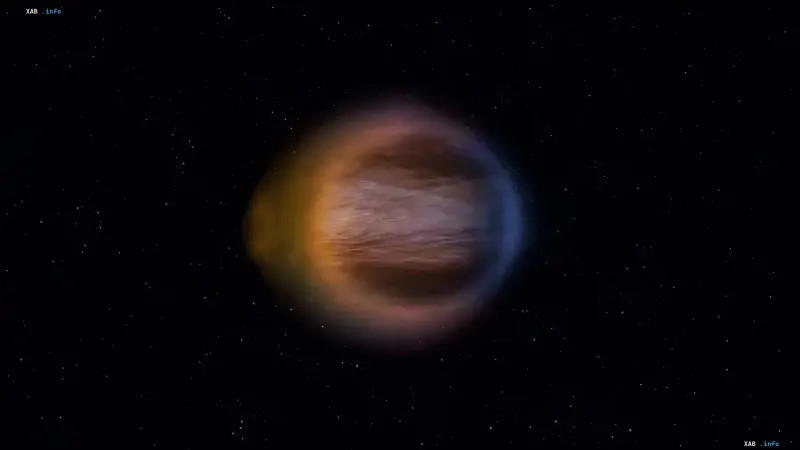
Astronomers analyzing data from the James Webb Space Telescope have concluded that the exoplanet WASP-17b, located approximately 1,000 light-years from Earth, is not perfectly spherical: its shape is slightly elongated and resembles an egg. The planet belongs to the class of hot Jupiters—gas giants orbiting at a very short distance from their star. Under such conditions, powerful tidal forces can significantly deform the planet's body, and researchers estimate this is reflected in the recorded shape.
How the Shape Was Measured via Transit
The method for assessing the shape is based on observing a transit—the passage of a planet in front of its parent star's disk. Scientists tracked how the star's brightness changed throughout the entire transit, and from this data calculated the distance from the planet's center to its edge in various directions. Comparing these values revealed a systematic deviation of WASP-17b from an ideal spherical shape, characterizing it as elongated.
Tidal Forces and Theoretical Models
The recorded deformation is consistent with theoretical models of gas giants experiencing strong tidal forces. Several factors may simultaneously influence the planet's shape: proximity to the star, tidal synchronization of its rotation, and internal atmospheric circulation. At the same time, the authors emphasize that transit observations alone cannot unambiguously separate the contribution of each of these mechanisms to the final shape.
Significance for Astrophysics
The result demonstrates that James Webb data allows scientists to study not only exoplanet atmospheres, but also their global shape. This approach opens up opportunities to more accurately test models of gas giant structure and determine how proximity to a star affects their physical properties. Further work will require comparing transit measurements with other observational methods to separate tidal and atmospheric effects.