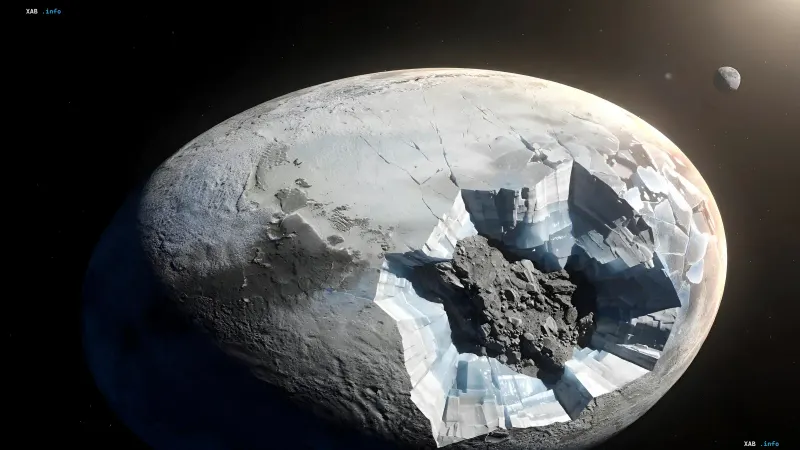
Astronomers have concluded that the dwarf planet Haumea, located beyond Neptune's orbit on the edge of the solar system, possesses a dense rocky core surrounded by an ice-rich mantle. The researchers reached this result by analyzing the motion of Haumea's two moons using observations from the Hubble Space Telescope gathered over two decades. Direct exploration of this distant celestial body's interior is currently impossible, so scientists resorted to an indirect method: from the nature of the moons' orbits, they estimated the mass distribution inside the planet and built a new dynamic system model.
Gravitational "Fingerprint" of the Interior: The J2 Parameter
The key analysis tool was the J2 parameter, which characterizes the deviation of Haumea's gravitational field from that of a perfectly spherical body. The more elongated the planet and the more unevenly its mass is distributed, the more noticeable this deviation. Astronomers simultaneously estimated the masses of the moons and the J2 value using precise measurements of the moons' positions obtained by Hubble over approximately twenty years. The resulting J2 value carries information about how precisely mass is concentrated inside Haumea: at the center or closer to the surface, in a dense core or in a looser mantle.
Stellar Occultations as a Shape-Determination Tool
To compare gravitational data with the planet's geometry, the researchers used stellar occultation observations. When Haumea passes in front of a distant star, the change in the star's brightness over time allows scientists to reconstruct the object's size and shape with high precision. Joint analysis of the measured J2 and shape models constructed from occultation data allowed astronomers to conclude that there are two main components to the interior: a dense rocky core and a surrounding ice mantle. This exact two-layer structure is in best agreement with the observed gravitational field and the planet's elongated shape.
What Remains Uncertain For Now
At the same time, the study's authors emphasize that Haumea's exact internal structure has not yet been established. Existing data are insufficient to reliably determine the density of the core and mantle or to unambiguously decide whether the planet consists of two main layers or has a more complex structure. Models also agree somewhat better with the assumption that Haumea retained part of its original deformed shape—the so-called "fossil" figure left over from early evolutionary stages. However, this statistical advantage is not yet convincing enough to consider the hypothesis confirmed.
Prospects and Significance for the Trans-Neptunian Population
Verifying and refining these conclusions will require new observations of Haumea's moons and additional stellar occultations, which will allow for a more precise determination of the gravitational field and planet shape, narrowing down the range of possible interior models. The authors also link the findings to a broader context: according to their assessment, rocky cores and subsurface oceans may be widespread among trans-Neptunian dwarf planets. However, this study did not confirm the presence of a subsurface ocean directly inside Haumea. The work contributes to understanding the geological and chemical evolution of small bodies at the edges of the solar system and sets guidelines for future missions and observations.