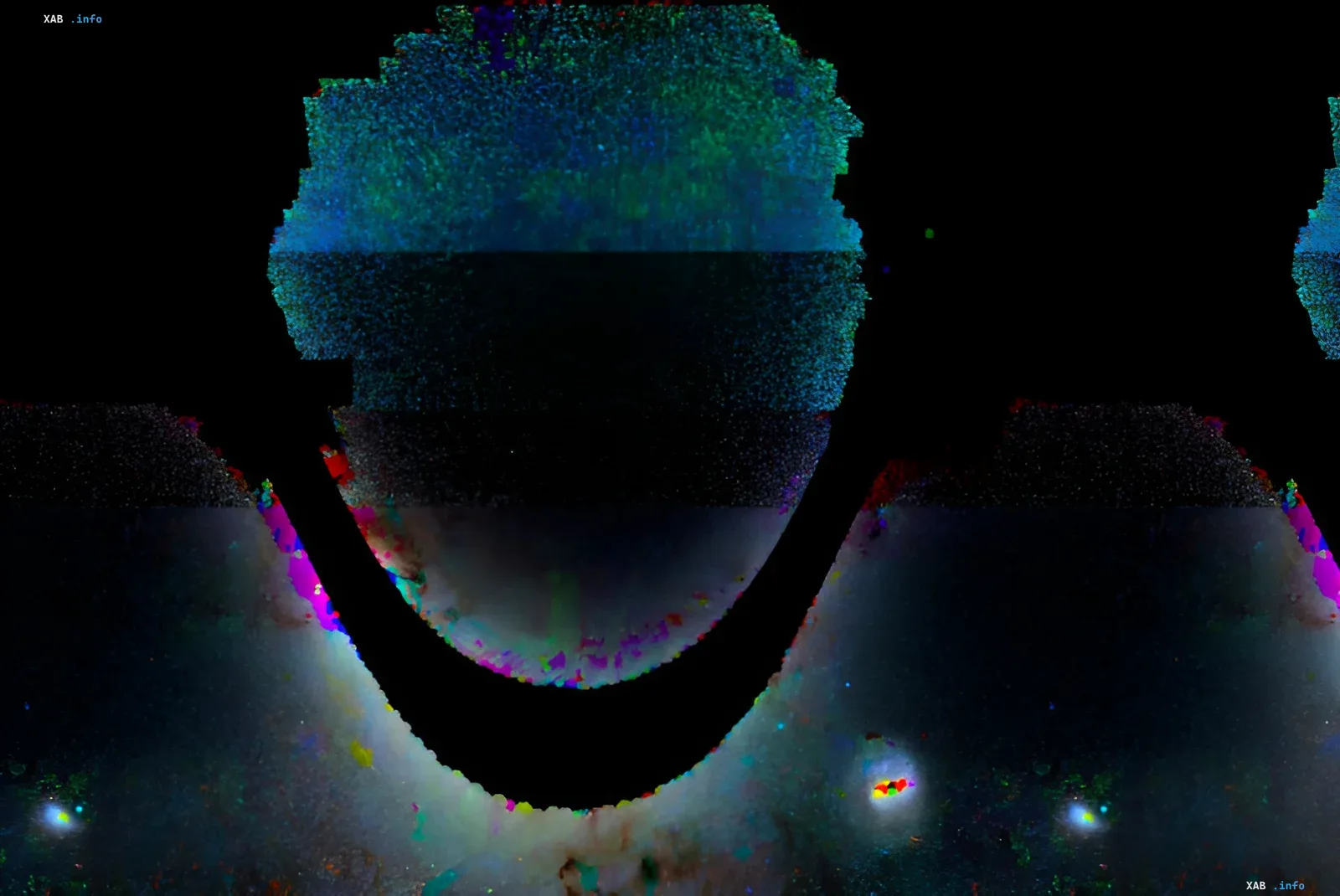
In August 2026, the astronomical community gained access to an unprecedented scientific tool — the most detailed color map of the night sky in human history. This digital atlas, created as part of the DESI (Dark Energy Spectroscopic Instrument) collaboration, covers approximately 75% of the celestial sphere and contains data on nearly 4 billion cosmic objects. The map, consisting of 5.6 trillion pixels, opens a new era in studying the structure of the Universe, allowing researchers to explore objects hidden behind dense clouds of cosmic dust in the visible and near-infrared ranges.
Technological breakthrough: from 263 thousand images to a single panorama
The creation of this giant image became possible thanks to the combination of data from several large-scale surveys. The project was based on the results of the five-year DESI survey, as well as data from the Dark Energy Camera Legacy Survey (DECaLS), Mayall z-band Legacy Survey (MzLS), and Beijing-Arizona Sky Survey (BASS). Multi-year infrared observations from the NASA WISE space telescope were also added. To form a single picture, a team of astronomers processed 263,407 individual exposures collected over 2,285 nights. Each frame required complex calibration taking into account atmospheric conditions, telescope characteristics, and camera sensitivity.
Supercomputer power and the role of artificial intelligence
Processing such a colossal volume of information required the resources of the Perlmutter supercomputer, located at the National Energy Research Scientific Computing Center (NERSC) at Berkeley Lab. It took a year to develop the software for combining images, while the actual processing of the entire data array took eight weeks. More than 160 scientists participated in data collection, and the final preparation of the dataset was performed by a team of 20 specialists. The resulting result is not just a photograph, but a complex catalog where the position and brightness in several spectral ranges are recorded for each source.
Search for dark energy and the future of astronomy
The main goal of the project remains determining the nature of dark energy. The map serves as an "input catalog" for the DESI spectroscopic instrument: it shows where galaxies are located, after which DESI determines their redshift, adding a third coordinate to the two coordinates in the sky — distance. This allows for the construction of a three-dimensional map of the large-scale structure of the Universe. The data is already being used to search for rare phenomena, such as supernovae and gravitational lenses. In addition, this array is considered a key training base for artificial intelligence systems that will in the future analyze petabyte archives of the Rubin Observatory and the Roman Space Telescope.
Contradictory data
While the technical side of the project is beyond doubt, the scientific conclusions based on DESI data are causing heated discussions in the scientific community. On the one hand, more than 1,800 published papers confirm the high accuracy of the instrument. On the other hand, DESI data has already caused doubts about the constancy of dark energy throughout the evolution of the Universe. If these hypotheses are confirmed, this could fundamentally change the standard cosmological model. The next release of the DESI survey, which is expected to shed light on these contradictions, is scheduled for the first half of 2027.