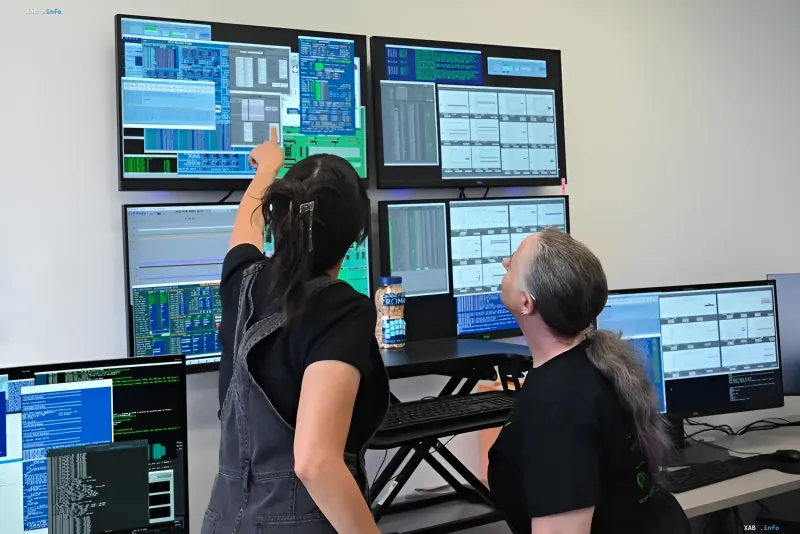
The Nancy Grace Roman Space Telescope (RST) team has completed the calibration of the primary wide-field instrument and fine-tuned its focus. Launched on August 30, 2026, aboard a Falcon Heavy rocket from Space Launch Complex 39A at the Kennedy Space Center in Florida, the telescope underwent a series of detector, filter, and thermal system tests following the activation of its primary wide-field multi-spectral infrared camera, the Wide Field Instrument (WFI), in September. NASA engineers announced that the image quality has surpassed pre-launch estimates.
Optical Error: 63 Nanometers Instead of 90
The WFI image quality requirement was set at 90 nanometers RMS—an optical error roughly one thousand times thinner than a human hair. Following final adjustments, the actual error of the Wide Field Instrument measured 63 nanometers RMS, which is nearly 30% better than calculated. "All cosmic survey images will be even sharper than we expected," said Alden Jurling, senior optical engineer for the project. By comparison, this level of precision means the optical system is operating at a standard that was not even guaranteed before launch.
Correction Smaller Than a Coin's Thickness
Achieving the required results demanded microscopic adjustments to the secondary mirror's position. According to the team, the mirror was shifted by approximately one-sixteenth of the diameter of a human hair. Jurling offered a vivid comparison: if the secondary mirror were scaled up to the height of the Empire State Building, the adjustment would be smaller than the thickness of a single-cent coin. Initially, the coronagraph instrument's image was slightly out of focus, though to a lesser extent than anticipated during design, making the correction relatively straightforward.
Significance for the Mission's Scientific Program
"Many of the mission's primary goals would be impossible without the WFI, so seeing it function properly is both a thrill and an enormous relief," said Dave Hickey, systems engineer. Named after Nancy Grace Roman, NASA’s first chief astronomer, the telescope is designed to study dark energy, dark matter, exoplanets, and the large-scale structure of the universe. Its field of view is significantly wider than those of Hubble and James Webb, allowing it to survey vast regions of the sky in a relatively short time. NASA expects Roman's observations to discover about 100,000 new exoplanets and gather data on over two billion galaxies.
What's Next: Coronagraph and Direct Exoplanet Imaging
In the coming weeks, the team will continue calibrating the coronagraph instrument and its mirrors. Following this phase, testing will begin on the system's ability to block starlight for the direct imaging of exoplanets—one of the mission's key scientific scenarios. The telescope is currently orbiting the Sun-Earth L2 Lagrange point, located approximately 1.5 million kilometers from Earth, and is undergoing pre-flight testing prior to transitioning to its primary science program.