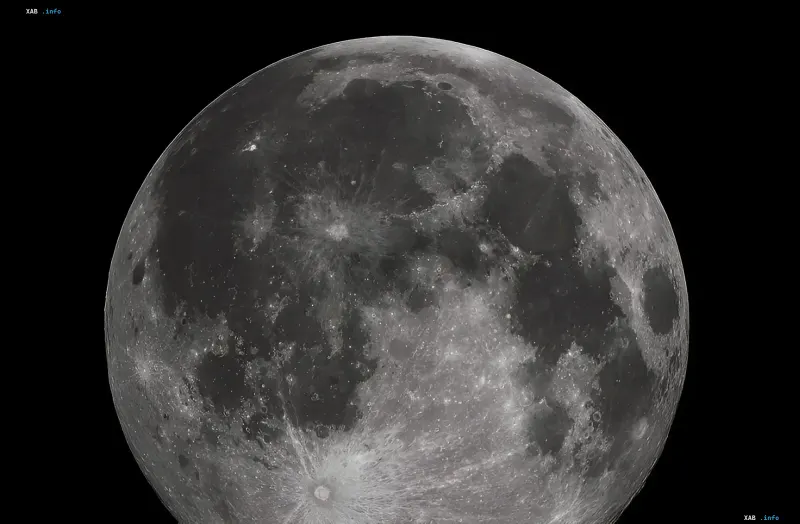
The Moon, seemingly a static and dead celestial body, is actually continuing to slowly but steadily change. According to a study published on October 14 in The Planetary Science Journal, the radius of Earth's only natural satellite has decreased by about 45 meters over the past 400 million years. At first glance, this is an insignificant figure, yet it has become the key to understanding that the Moon's geological activity has not completely ceased, but rather transitioned into a different, quieter phase that could have direct consequences for future crewed missions.
How scientists measured the Moon's contraction
The research team analyzed millions of images captured by the Lunar Reconnaissance Orbiter Camera (LROC) over 17 years of continuous observations. Processing this massive dataset revealed that the Moon is shrinking at a rate of roughly 6 to 11 centimeters per million years. It is on the satellite's surface that scientists identified more than 10,000 relatively young geological faults—structures known in scientific literature as lobate scarps. Their presence indicates that the lunar crust continues to contract and crack rather than remaining in a state of complete geological dormancy as previously assumed.
The mechanism of contraction: from a hot core to a wrinkled crust
The reason for the Moon's reduction in size lies in the gradual cooling of its inner core. As it loses heat, the internal layers of material contract, while the outer crust, unable to 'catch up' with the shrinking volume, wrinkles and becomes covered with a network of cracks. The study compares this process to a dried grape: the pulp shrinks while the skin forms characteristic wrinkles. On the Moon, a similar mechanism produces small cliffs and faults, which are recorded by orbital cameras. Similar processes were previously documented on Mercury, where in 1974 the Mariner 10 spacecraft discovered kilometer-high slopes indicating crustal contraction due to interior cooling.
Seismic threat: why faults are dangerous for astronauts
The primary concern expressed by the study's authors is that the discovered faults are capable of generating moonquakes. On Earth, about 90% of seismic activity is concentrated near tectonic plate boundaries, making risk zones somewhat predictable. The Moon has no such system: its crust contracts and fractures in various regions as the entire celestial body cools. This means moonquakes could potentially occur at virtually any point, significantly complicating the prediction of safe zones for construction.
Impact on the Artemis program and base site selection
This discovery takes on particular relevance against the backdrop of NASA's and other space agencies' plans to return humans to the Moon under the Artemis program. If an earthquake occurs near a landing site or the construction zone of a future lunar base, underground tremors and the risk of landslides could damage equipment, structures, and directly threaten astronaut safety. Consequently, determining the exact location of faults and assessing seismic risk are becoming critically important steps in selecting sites for future missions. Scientists emphasize that the Moon's contraction process occurs extremely slowly and does not mean the celestial body will disappear or significantly shrink in the foreseeable future. Nevertheless, for engineers and planners of lunar infrastructure projects, even minor seismic events can become a factor determining architecture and the placement of objects on the satellite's surface.
Origin of the Moon and context in the Solar System
According to the prevailing hypothesis supported by most planetary scientists, the Moon formed billions of years ago as a result of a massive collision between the early Earth and a large celestial body. The hot material ejected into space after the impact gradually condensed, forming the satellite. Since then, the Moon has been steadily losing heat, and it is this process, stretching over hundreds of millions of years, that today manifests as thousands of faults on its surface. Comparing data from the Moon and Mercury allows scientists to build more accurate models of the thermal evolution cycle of solid bodies in the Solar System and, consequently, better understand the geological risks humans might face on other celestial bodies.