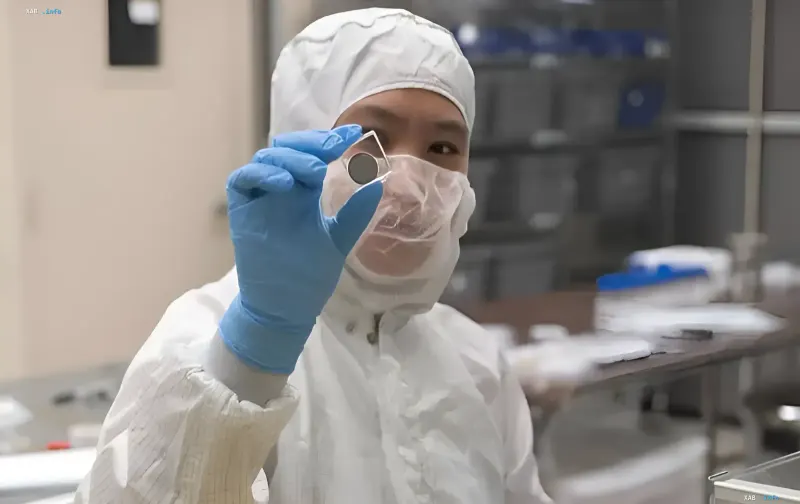
NASA scientists have successfully completed a series of tests on an innovative solid-state battery prototype developed under the SPEARS project, capable of withstanding extreme cooling down to -170 degrees Celsius without internal damage. The new development aims to ensure uninterrupted power supply for future lunar missions, where nighttime conditions near the Moon's South Pole create insurmountable obstacles for traditional power systems.
The Problem of Traditional Space Batteries
Traditional lithium-ion batteries are completely unsuitable for operation during the lunar night, when surface temperatures can drop to a critical -200 degrees Celsius. Under such harsh conditions and deep vacuum, the liquid electrolyte inside standard batteries freezes completely, and under certain circumstances begins to boil or expand, leading to irreversible equipment failure. NASA engineers found a technological solution by applying a rigid ceramic or polymer electrolyte in the new design.
Results of Laboratory Prototype Testing
During detailed tests at the Langley Research Center in Virginia, researchers recorded impressive performance indicators for the new power source. Stable energy generation is ensured within the range of -60 to +80 degrees Celsius, and when cooled to -80 degrees, the batteries maintain functionality, albeit with reduced performance. In the ultimate endurance mode, the cells successfully survived temperature exposures from -170 to +100 degrees Celsius without any physical damage to their structure.
Behavior Under Extreme Cold Conditions
NASA specialists clarify an important nuance of the battery's operation: upon reaching the extreme mark of -170 degrees Celsius, the cell temporarily stops generating electric current, but its internal structure remains completely intact. To fully restore functionality and resume normal operation, only a brief external warming is required. This completely changes the approach to designing lunar equipment, eliminating the need for engineers to install cumbersome thermal control systems.
Significance for Lunar Exploration and Earth Applications
Eliminating heavy continuous heating systems will significantly reduce the total mass of spacecraft, lunar rovers, and scientific instruments, saving a substantial share of scarce energy. The new solid-state batteries are planned for active use in lunar vehicles, autonomous scientific equipment, and critical emergency systems for astronauts under the Artemis program. In the long term, this technology could be adapted for terrestrial needs, including electric vehicles, aviation, unmanned aerial vehicles, and reliable portable electronics.