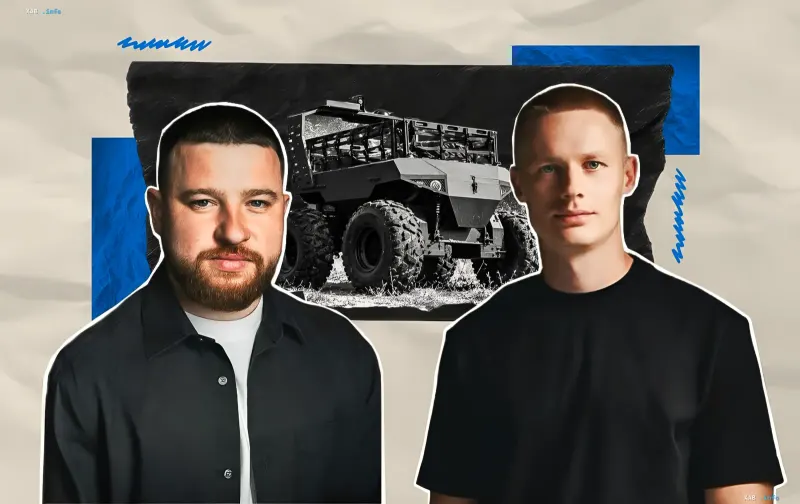
Unmanned ground vehicles (UGVs) on the frontline perform a wide range of logistical tasks, with wounded evacuation being one of the most critical. RBC-Ukraine spoke with Air3F co-founders Ihor Berehovenko and Sviatoslav Kulbatskyi about why their drone is built on wheels rather than tracks, how the team arrived at the current chassis architecture, and what limitations the very nature of remote control dictates. The conversation also touched upon component localization and the export potential of the development.
From custom manufacturing to military tasks
According to Ihor Berehovenko, even before the full-scale invasion, the team had its own production facility specializing in custom-made items. This meant that equipment, production capacities, and experience in implementing non-standard technical solutions were already in place. With the outbreak of the invasion, the company decided to direct these capabilities toward creating products needed by the military and changed its profile. As the founders note, the UGV idea grew out of direct conversations with the military: one of the biggest requests was delivering supplies over significant distances without direct human involvement.
Prototype evolution: from hoverboard to balancing suspension
Sviatoslav Kulbatskyi describes the path of creating the complex as a series of experiments. The first prototype of the ground drone was assembled using small hoverboard wheels, but the team quickly realized the flaw in this decision: transporting about 20 kilograms per trip meant wasting the most valuable resource—time. Transitioning to larger wheels improved off-road capability but revealed a new obstacle—insufficient surface traction, especially on muddy or loose soil. It became clear that a suspension was needed. A classic independent suspension, like in modern cars, was unsuitable for a drone: in a regular car, a driver feels the terrain with their own body in seconds and balances the load, whereas a UGV operator controls the vehicle from a safe distance and lacks this sensitivity. The technical solution was precisely the balancing suspension.
Why wheels instead of tracks
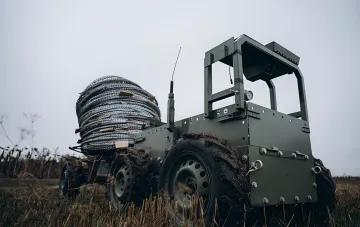
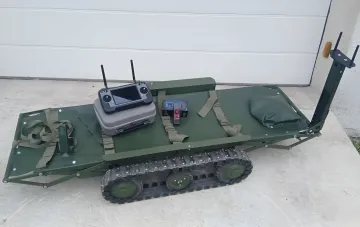
A tracked platform, the founders admit, has obvious advantages—good surface traction and even mass distribution—and at first glance looks optimal for a UGV. In practice, however, it has significant drawbacks. The first is suspension complexity: if cargo is transported, it is important to deliver it undamaged, and during wounded evacuation, requirements for smooth movement are even higher. The second is the risk of throwing a track: on complex or loose soil, especially during high lateral load turns, a track can come off its guides, effectively meaning a loss of mobility. The third is noise, caused by the specifics of surface contact and the large number of moving mechanisms in the chassis, especially on hard surfaces. Therefore, the team focused on a wheeled platform, but did not replicate the traditional 4x4 scheme with a single engine and mechanical power transmission: instead, they chose a solution with an independent motor for each wheel, allowing them to control each wheel's drive independently and distribute traction more efficiently depending on driving conditions.
Speed, control, and the question of weaponry
The company has not considered offensive weaponry, though some self-defense means—such as increasingly popular net guns—might well appear. On the frontline, there is a high demand for machines with a large operating radius because missions are usually long, while the UGV's speed is low—up to 20 km/h. Making the drone faster is technically not a problem, but serious control difficulties then arise due to video signal delays: if the complex travels at 10–15 km/h and the signal drops for a fraction of a second, it covers only a meter or two, whereas at 60–80 km/h in the same time it would cover about ten meters and could crash into an obstacle or flip over. As for a larger UGV, the founders admit they have thought about it, but are currently fully focused on improving the existing version.