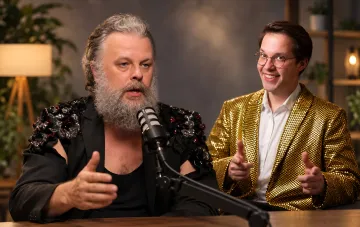
Against the backdrop of the ongoing full-scale war, issues of cultural identity and the propriety of public performances by Ukrainian artists remain sharp topics for public discussion. Albert Tsukrenko, a well-known musician and member of the group 'Hammerman Znyshchuye Virusy', in a recent interview with the 'TSE BAZA' podcast, analyzed the influence of public figures on the perception of Ukraine abroad and the harm of 'cancel culture' within the country. In his opinion, attempts to radically cancel artists based on complaints have a destructive effect on the unity of Ukrainian society.
Artist's position in wartime
Tsukrenko emphasized that any actions — from daily habits to public performances — take place 'against the backdrop' of difficult war events. Responding to criticism of his provocative stage image, the musician noted that he does not consider it inappropriate. He views his work as a tool for destigmatization and the fight against xenophobia, arguing that society must learn to accept diverse forms of self-expression as long as they do not cross legal boundaries. Tsukrenko describes his activity as a way of 'demagnetizing' aggressive rejection of the other.
Cultural conflict and the 'aggressive majority'
Reflecting on regional differences in the perception of art, the artist refuted the thesis that rejection of provocative performances is tied to the geography of Ukraine. He pointed out that conflicts surrounding his performances occurred both in the west of the country and in other regions. Tsukrenko characterized his critics as an 'aggressive cultural minority' that tends to pass itself off as the majority. It is these groups, according to the musician, that most often provoke concert cancellations, guided by personal or political prejudices rather than public interests.
European tour as a tool for uniting the diaspora
As part of his activities, which go beyond the band 'Hammerman Znyshchuye Virusy', Albert Tsukrenko announced a European tour dedicated to Ukrainian retro music. The goal of this project is to create a new reason for the consolidation of Ukrainians forced to stay abroad. The artist notes that over time, the activity of the diaspora decreases due to assimilation and the habituation of host societies to the topic of the war. Through cultural projects, he seeks to maintain the connection of Ukrainians with their homeland and with each other in conditions of long-term residence outside of Ukraine.
Contradictory data
In the public sphere, there are different assessments of the influence of artists who have continued or continue to tour abroad while combining this with the Ukrainian agenda. Critics of artists like Potap or Dorn point to the danger of returning to the common post-Soviet cultural space with Russia. At the same time, members of the art community, including Tsukrenko, emphasize that internal conflicts and 'witch hunts' within Ukraine often cause more damage than the ambiguous performances of individual artists outside the state.