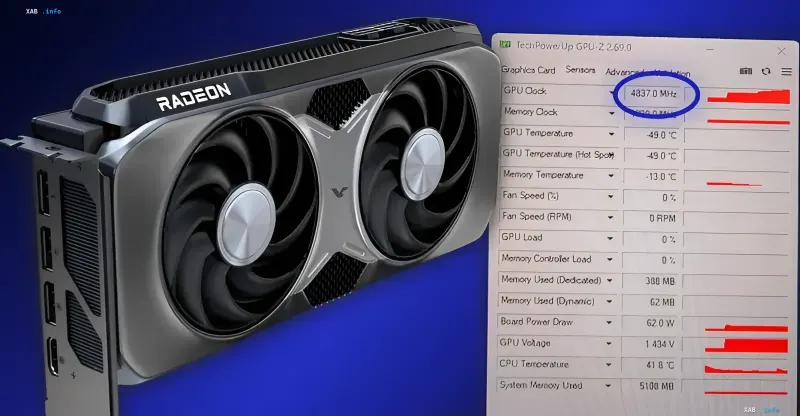
Jack Huynh, Senior Vice President and General Manager of AMD’s Computing and Graphics Group, has unexpectedly co-authored a world record for GPU overclocking. Together with well-known overclocker Bill Alverson, known under the pseudonym Sampson, he recorded a clock speed of 4837 MHz for the Radeon RX 9060 XT graphics card on November 15. The achievement has been added to the OC World Record Museum database, maintained by enthusiast SkatterBencher, and as of the time of publication, it is the highest GPU frequency overclock ever registered in this database.
How the Record Was Set
The result of 4837 MHz was achieved using extreme liquid nitrogen cooling — a standard method for record-breaking overclocks, which keeps the silicon functional at extreme voltages and frequencies. The new figure surpassed the previous record of 4789 MHz, set in June by the same Sampson, then paired with overclocker SoonHo, by 48 MHz. Thus, AMD specialists and partners remain the record holders for GPU frequency, underscoring the company’s systematic work on the overclocking potential of its chips.
Record History on the Navi 44 Architecture
This is by no means the first time AMD has demonstrated the frequency headroom of its Navi 44 GPU architecture. Back in February, the company's specialists managed to reach 4769 MHz on the same model. Later, in June, Sampson showed a result of 4643 MHz using an engineering sample and internal AMD tools to adjust clock speeds. The gradual approach to the 5 GHz milestone over the past few months testifies to the stable growth of the chip’s overclocking potential as cooling techniques and methodologies are refined.
Exceeding Factory Specifications
The official maximum Boost clock of the Radeon RX 9060 XT is 3130 MHz. The new record of 4837 MHz exceeds AMD’s reference specifications by approximately 54.5%, which is an impressive margin for a consumer GPU. For comparison, the result is also 817 MHz higher than the frequency record for the GeForce RTX 4090, set by user Splave in July 2023. This allows us to consider the Navi 44 one of the most overclockable chips of the current generation compared to its competitors.
Can AMD Break the 5 GHz Barrier?
The main question remaining for the overclocking community is whether AMD will be able to cross the psychological 5 GHz mark for RDNA 4 architecture GPUs. The company is only 163 MHz away from this milestone, and considering that previous records on the same chip grew by hundreds of megahertz in just a few months, overcoming the 5 GHz border looks quite likely in the near future. Subsequent overclocking attempts will likely be aimed at this specific target.