On Reddit, a user under the handle danthebigboss published a story that quickly spread across specialized outlets, including VideoCardz and iXBT. The buyer ordered an AMD Ryzen 9 9950X3D processor on Amazon and received it in a sealed retail package. However, after unboxing, it turned out that what they had in their hands was not an ordinary flagship chip, but a so-called 'Ryzen 9 9950X3D Dual Edition' — a device that cannot be used as intended. The incident became yet another example of how counterfeit or joke CPUs end up on major marketplaces.
What the buyer showed: A 'double' processor
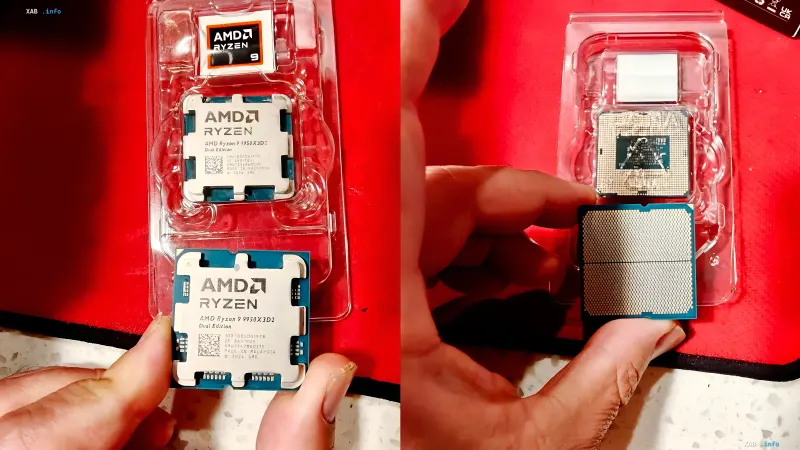
According to the published photographs, the top part of the received processor features a familiar Integrated Heat Spreader (IHS) labeled AMD Ryzen 9 9950X3D Dual Edition. The lid bears characteristic AMD RYZEN inscriptions, a QR code, and serial designations including OPN 100-000001978, code CF 2601PGY, and the marking 'MADE IN MALAYSIA, © 2024 AMD'. Externally, the packaging and IHS look like a standard retail product, making the deception non-obvious until the bottom side is inspected.
AMD on top, Intel on bottom
Suspicions of fraud arose immediately after the buyer turned the chip over: instead of an AMD Socket AM5 contact pad, the substrate featured an Intel LGA1151 pin grid array. The images clearly show that the lower part of the 'processor' is essentially an Intel substrate with a characteristic central die pad and an LGA1151 contact grid, rather than an AM5 contact pad. Thus, a 'hybrid' was created: an AMD Ryzen 9 9950X3D lid on top, and an Intel substrate on the bottom. Using such a 'CPU' is impossible in any motherboard, as neither the socket nor the electrical layout matches any real product.
Context: A wave of CPU counterfeits on Amazon
The 'Dual Edition' story is not an isolated incident. Previously, specialized outlets and the GamersNexus channel examined a counterfeit AMD Ryzen 7 9800X3D received from an Amazon buyer: after heating and removing the IHS, it turned out that the substrate contained no chiplets, memory blocks, or I/O interfaces at all, and the number and orientation of capacitors, font, and top inscriptions did not match the original. This demonstrates a steady trend — both completely fictitious microchips and 'mixed' designs, where a real lid is combined with a foreign or empty substrate, are appearing on marketplaces.
What is known about returns and how to protect yourself
As of the time of publication, there is no information on whether the buyer managed to get a refund or a replacement. Amazon has not publicly commented on the incident, and AMD has not issued a statement in the provided materials. Experts recommend purchasing processors only through official channels and authorized resellers, checking packaging integrity, and comparing IHS markings, OPN codes, and contact pad types with original product specifications if any doubts arise. Until official comments from the parties emerge, the case remains a documented complaint from a single buyer with photographs, but without independent expert analysis.