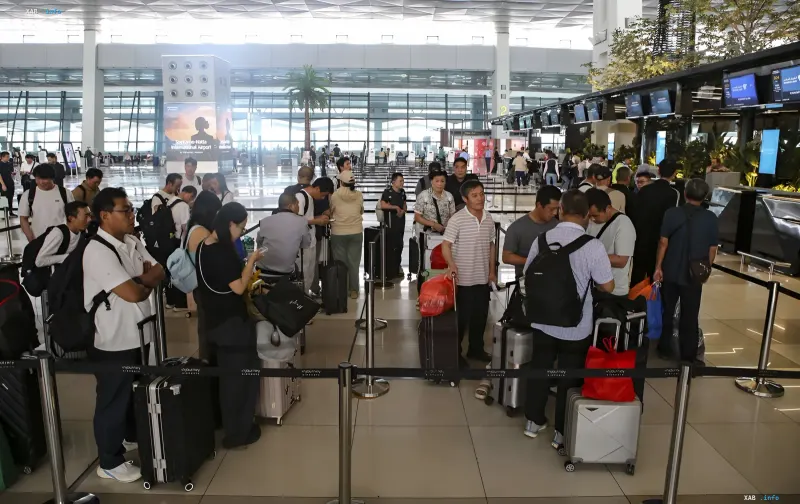
In Indonesia, the aftermath of the Anak Krakatau volcano eruption has led to the suspension of operations at seven airports, including two aviation hubs serving the capital, Jakarta. According to the country's Ministry of Transport, around 170,000 passengers were affected by flight cancellations and delays. The volcano, located in the Sunda Strait between the islands of Java and Sumatra, began erupting late on the evening of September 6, and the spread of ash over Jakarta and surrounding areas made flights unsafe. Indonesia lies on the Pacific Ring of Fire — a zone of tectonic plate convergence characterized by high volcanic and seismic activity.
Eruption Timeline
Activity at Anak Krakatau had been building up over several days. On Saturday, the volcano ejected fountains of lava, and loud sounds from its activity were reportedly heard from several hundred kilometers away. New eruptions continued on Sunday; the latest was recorded at 20:23 local time. It was the detection of volcanic ash in the airspace near the airports that prompted their suspension for safety reasons.
Paralysis of Air Traffic
Authorities suspended operations at seven airports: in addition to the two Jakarta hubs, these include airfields in the neighboring provinces of Lampung and West Java. The closure was extended to at least the end of the day on September 7. Indonesian Transport Minister Dudy Purwagandhi stated that it is impossible to predict exactly when the situation will normalize due to changing weather conditions. According to the ministry, 1,558 flights were delayed or cancelled across the eight airports whose operations were disrupted by ash, with more than 900 of them at Soekarno-Hatta International Airport, Jakarta's main air gateway. Passengers had to seek alternative routes, while vessels transiting the Sunda Strait were advised to heighten vigilance due to navigation risks.
Consequences Beyond the Airports
The impact of the eruption extended far beyond aviation. On Monday, schools across Jakarta switched classes to an online format. Ash reached the city of Bandar Lampung on the southern edge of Sumatra: local residents reported a layer of ash on parked cars and road shoulders. Authorities banned anyone from approaching the volcano closer than three kilometers.
Historical Context of Anak Krakatau
The name Anak Krakatau translates as "child of Krakatau." This new volcano began forming above water in 1927 in the depression left by the catastrophic 1883 eruption of Krakatau, which killed around 35,000 people. In 2018, part of Anak Krakatau collapsed into the sea, triggering a powerful tsunami that claimed 429 lives and forced thousands of residents to leave their homes. Indonesia's volcanological agency warned of a high likelihood of new eruptions in the near term, while the head of the geological agency, Lana Sari, stated that the current series of eruptions has no potential to trigger a tsunami.
Contradictory Data
The primary sources contain discrepancies that are important to keep in mind. First, one passage refers to seven closed airports, while another mentions eight airports whose operations were disrupted by ash; the difference likely stems from the fact that some hubs were operating with restrictions rather than being fully closed. Second, the exact timeline for the normalization of air traffic is unknown: authorities extended the closure only until the end of September 7, and the transport minister explicitly pointed to the impossibility of predicting when the restrictions would end. Third, the linking of days of the week to dates in the source (the eruption "on Friday, September 6") does not always align with the 2026 calendar, so the chronology should be treated as approximate, relying on the dates of September 6–7.
As of September 7, the situation remains tense: the volcano continues to show activity, airports are operating in a limited mode, and authorities maintain the ban on approaching the crater. The main factor of uncertainty remains the weather conditions, which determine the direction and speed of the ash cloud's spread.