During a preliminary survey of the seabed prior to the launch of an offshore wind farm project, archaeologists made a unique discovery. Off the southern coast of Italy, in the waters of the Ionian Sea, an ancient ship was found that has lain at the bottom for more than 2,400 years.
Ship of the Ancient Era
The site of the discovery is located off the coast of Calabria, near the municipality of Monasterace in the province of Reggio Calabria. According to preliminary expert estimates, the ship dates back to the 5th–4th centuries BC. This was a time of the flourishing of trade links in the Mediterranean, when sea routes connected major Greek city-states.
The discovered ship became not just an artifact, but material confirmation of historical data. Previously, information about trade links in this region was known primarily from written sources and scattered finds on land. Now, archaeologists have the opportunity to study the real picture of maritime transport of that time.
Currency of the Ancient World: 300 Amphorae
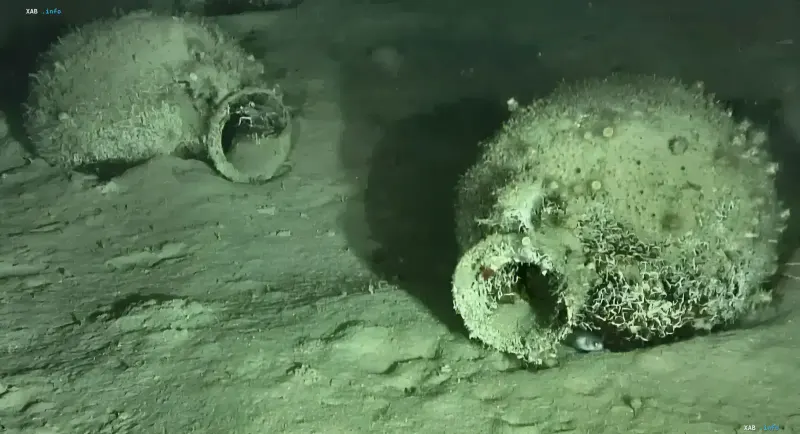
The main value of the find is the preserved cargo. On board the ship, archaeologists recorded more than 300 amphorae — large clay vessels that in the ancient world served as the main container for transporting wine, olive oil, grain, and other goods.
Amphorae are of particular interest to historians. Their shape, stamps, and material allow establishing not only the approximate time of the disaster but also trade routes and the origin of the cargo. According to researchers, the vessels were manufactured in various production centers of Magna Graecia and Sicily. This indicates that the ship was part of an active regional trade network connecting Greek settlements in southern Italy.
The wreck site is located near the ancient Greek city of Caulonia, founded before 700 BC. In antiquity, this area of Calabria was an important hub of maritime contacts, through which not only goods but also ideas and cultural influences passed.
Trawl Fishing and the Threat of Loss
During a photogrammetric survey conducted in 2025, specialists recorded two groups of amphorae located approximately 10 meters apart. Experts suggest that the primary arrangement of the cargo may have been disturbed in modern times.
One of the likely reasons for the scattering of artifacts is trawl fishing. Heavy fishing gear dragged across the seabed could have snagged the wreck site and scattered some of the amphorae. This is why archaeologists insist on the need for urgent documentation and protection of the monument. Without timely intervention, part of the historical evidence may be irretrievably lost or damaged.
Energy and Archaeology: Seeking a Compromise
The ship was discovered not during classical excavations, but as part of research for a future energy project. The company ACCIONA Energía conducted a seabed survey to determine possible archaeological, environmental, and technical constraints for the construction of the wind farm in advance.
After the discovery of the ship, the project was adjusted. The company changed the initial design to bypass the area of archaeological value and avoid damaging it during future work. The Italian Ministry of Culture supported further research, documentation of the wreck site, as well as the removal and conservation of the most vulnerable artifacts.
This discovery demonstrates how modern infrastructure projects can contribute to the discovery of ancient history, provided there is competent planning and respect for cultural heritage.