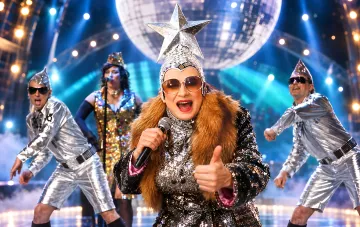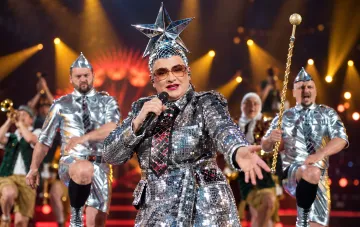
Verka Serduchka's star is well known far beyond Ukraine today: her name is recognized from Lisbon to Tokyo, and the hit "Dancing Lasha Tumbai" is still played at parties worldwide. However, Andriy Danylko's path to the big stage did not begin with concert halls or television screens at all. His childhood was spent in Poltava, where the future artist experienced the early loss of his father, shyness, and insecurity, while showing his first creative abilities during his school years. Styler tells the story of how the biography of the man who later became one of the most recognizable stage characters in the history of Ukrainian show business took shape.
A Modest Family and Early Loss
Andriy Danylko was born on October 2, 1973, in Poltava. His family lived quite modestly: his father Mykhailo worked as a driver, and his mother Svitlana had to work hard to provide for the children. According to 5-tv.ru, his mother Svitlana Ivanivna was a painter by profession, and Andriy had an older sister, Halya, born from a different father. When Andriy was seven years old, his father died of cancer. After that, the future artist and his sister were raised by their mother alone. In a later interview with the publication Vysokyi Zamok, Danylko recalled that the family lived in a private sector area: five people lived in a small room, and there were no usual household amenities, including a bathroom or shower, so they had to wash at relatives' homes. The artist also spoke about complex family relationships, partly caused by his father's alcohol dependence, but at the same time emphasized that he remembered him as a good person when he was not drinking alcohol.
A Shy Student and School KVN
The future artist studied at Poltava School No. 27. According to the memories of the former head of the institution, Danylko was a rather modest and shy guy: he did not seek to attract attention to himself, and in his studies, he did not stand out with high grades. Andriy himself later admitted that exact sciences were difficult for him, and he was much more interested in creativity. He attended an art school, studied in a theater studio, and actively participated in school amateur performances. KVN held a special place in his life: Danylko became the captain of the school team, which regularly performed at competitions. It was there that he got the opportunity to experiment with humor, stage images, and behavior in front of an audience. In an interview with Vysokyi Zamok, the artist said that serious school subjects interested him little, while the theater studio gave him genuine pleasure.
Unsuccessful Admissions and the Vocational School Path
After graduating from school in 1991, Andriy wanted to connect his life with art. He submitted documents to the Poltava Mykola Lysenko Music College, but did not pass the creative competition. Afterwards, he tried to enter the pedagogical institute, but this attempt was also unsuccessful. As a result, Danylko went to study at Vocational School No. 30, where he received the specialty of a grocery cashier-salesman. However, even studying a completely non-creative specialty did not make him abandon the stage: Andriy continued to perform in the vocational school's KVN team. It was during this period that the character of the saleswoman began to appear, which later turned into one of the most famous heroines of Ukrainian show business. Later, the artist entered the Kyiv Variety and Circus College, where he studied in the spoken genre department.
Birth of the Character: From a Sketch to a Legendary Image
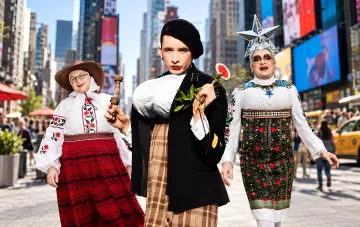
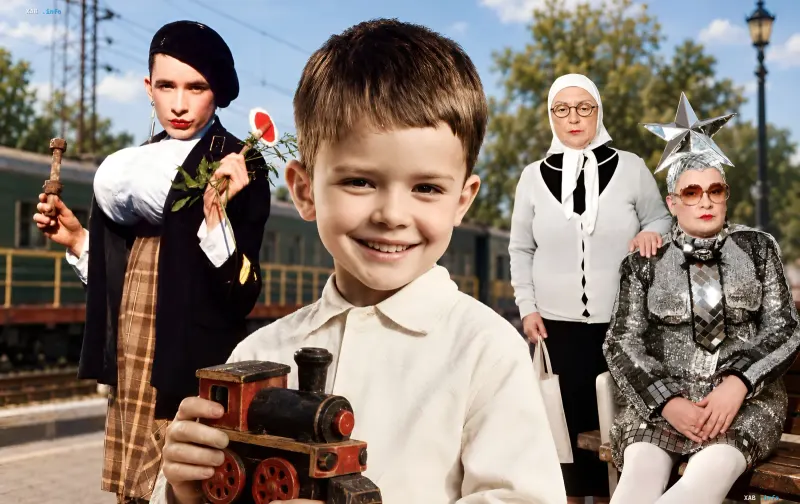
Danylko began working on the image of Verka Serduchka back in 1990. At first, it was not a female train conductor with famous songs, but a comedic character performing in small sketches. Andriy first appeared on the big stage in this image on April 1, 1993, during the Poltava "Humorina". At that time, he presented the routines "The Canteen" and "The Female Conductor". The audience saw a woman with a characteristic voice, bright clothing, and an unusual star on her head. The character's name had quite specific prototypes: in an interview with Vysokyi Zamok, Danylko said that he borrowed the surname Serdychka from his classmate Anya Serdyuk, who studied well, and took the name Verka from the school cleaning lady named Baba Vera. Thus, gradually, an ordinary comedic number turned into a full-fledged stage image: Danylko did not just dress up as a woman, but created a separate heroine with her own character, communication style, and recognizable behavior.
From Poltava to Eurovision
The first performances in his hometown marked the beginning of the artist's professional path. Afterwards, Danylko began touring, and his character gradually gained popularity outside of Poltava. In 1997, he became the host of the "SV-show" program on the 1+1 TV channel. The format of the broadcast involved conversations with invited celebrities, and Verka Serduchka quickly became a recognizable television heroine. Then came musical hits, concerts, and roles in television musicals. The greatest international success was Verka Serduchka's performance at the 2007 Eurovision Song Contest in Gelsenkirchen, where the song "Dancing Lasha Tumbai" got all of Europe dancing and entered the ranks of the most recognizable numbers in the history of the contest. Since then, the image born in the Poltava KVN team of a shy schoolboy has become an integral part of global pop culture.