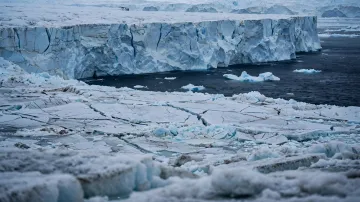
In 2026, the area of the ozone hole over Antarctica reached 27.1 million km², which is approximately 90% of the record high observed in 2000. According to the press service of the National Antarctic Scientific Center (NASC), this is the largest ozone anomaly in the last decade. However, experts emphasize that area is only one characteristic of the phenomenon, and when considering all parameters, the current situation is not catastrophic.
How the Ozone Hole is Measured and What "Depth" Means
Every year, a section of the atmosphere over Antarctica is recorded where the total ozone content—a gas that protects the planet from harmful ultraviolet radiation—drops sharply. The ozone hole primarily exists during the Antarctic spring, which corresponds to the autumn months in Ukraine. The total amount of ozone in an atmospheric column over a specific point is measured in Dobson Units (DU). According to the NASC, the normal content is 300–400 DU, while the "threshold" for an ozone hole is less than 220 DU. This is why specialists pay attention not only to the area of the anomaly but also to its "depth"—the degree of ozone concentration reduction.
Record Area, but Ozone Concentration is Not Abnormal
Sergiy Yakushchenko, an ozonometrist of the 31st Ukrainian Antarctic Expedition (UAE), noted that although the 2026 ozone hole was large in area, no abnormally low ozone concentration values were recorded in the atmosphere. Specifically, on October 9–11 of this year, total ozone levels reached 372–374 DU, which is within the normal range. Thus, despite the impressive dimensions of the anomaly, its "depth" turned out to be moderate, which significantly reduces the potential impact on the ecosystem and public health.
The Cause: An Abnormally Powerful Polar Vortex
The NASC stated that the main reason for the formation of a large ozone hole in 2026 was an abnormally powerful polar vortex. This atmospheric phenomenon creates stable conditions for ozone destruction in the stratosphere: cold temperatures within the vortex facilitate the formation of polar stratospheric clouds, on the surface of which chemical reactions involving chlorine and bromine occur, released from ozone-depleting substances. It was the combination of these factors that led to the expansion of the anomaly to 27.1 million km².
Long-Term Recovery Trend Remains
Despite the large size of the ozone hole in 2026, NASC experts emphasize that the long-term trend toward ozone layer recovery remains. Scientists attribute this to the reduction in the production and use of ozone-depleting substances thanks to international agreements—primarily the 1987 Montreal Protocol. At the same time, experts warn that atmospheric conditions can cause significant fluctuations from year to year, and individual large anomalies do not cancel out the overall positive trend.
Context: Ukrainian Research in Antarctica
Data on the 2026 ozone hole were obtained, among other sources, thanks to the work of Ukrainian polar explorers at the Akademik Vernadsky station. The 31st Ukrainian Antarctic Expedition continues a long-term atmospheric monitoring program, including ozone measurements using ozonometers. Previously, Ukrainian researchers have recorded unique atmospheric phenomena at the station—from "soap bubbles" in the sky to reddish auroras, as well as historical temperature records, highlighting Ukraine's role in global climate and atmospheric research.