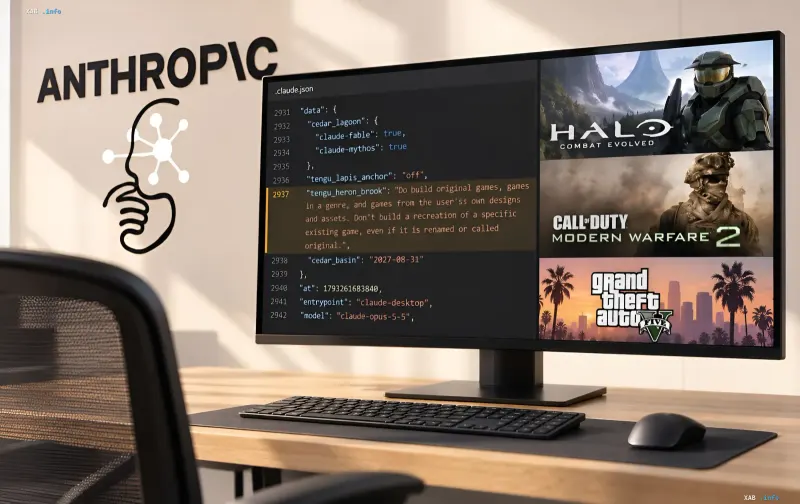
Anthropic has introduced new server-side restrictions to its AI programming tool, Claude Code, prohibiting the neural network from recreating existing video games. The changes were spotted by users on platform X in the .claude.json configuration file and later officially confirmed by Anthropic technical team representative Eddie Aftandilian. According to the updated directive, the Opus 5.5 model is now required to refuse the generation of copies of third-party titles, even if the user attempts to rename the project or position it as original. Meanwhile, creating completely original games from scratch, developing within specific genres, and using one's own assets remain permitted.
What exactly changed in Claude's code
A screenshot published online shows a fragment of the .claude.json configuration file, where a new instruction is fixed on line 2937: "Do build original games, games in a genre, and games from the user's own designs and assets. Don't build a recreation of a specific existing game, even if it is renamed or called original." This directive operates at the server level, meaning bypassing it via prompts or local settings is impossible. According to Aftandilian, the Anthropic team continues to refine the system to find the "right balance between creative freedom and legal compliance."
Legal context: why now
The update comes against the backdrop of intense pressure in the intellectual property arena. Last year, Anthropic agreed to pay a record $1.5 billion settlement in a class-action lawsuit filed by 500,000 authors accusing the company of using copyrighted materials to train its AI models. Recently, a similar lawsuit was filed against developers by the owners of Elvis Presley’s intellectual heritage. Amid these events, tech giants are forced to exercise stricter control over the use of their tools to generate content that could potentially infringe third-party copyrights.
The wave of "vibe-coded" fan projects
A direct trigger for the update was the surge in popularity of so-called vibe-coded projects—games that enthusiasts decompile and adapt to run in standard web browsers using AI. Among the most prominent examples mentioned in public discussions are Halo: Combat Evolved, Call of Duty: Modern Warfare 2, and Grand Theft Auto V. Such projects, in Anthropic's logic, create the highest risk of copyright infringement for publishers and developer studios, and it is their recreation that is now blocked at the model level.
False positives: who is affected unintentionally
However, the strict filters have already begun blocking entirely legitimate work. The founder of Conflict Simulations studio complained that Claude flatly refused to continue writing original code for custom digital modules for tabletop wargames. Issues also arose for specialists using the neural network for reverse engineering and PC game optimization—specifically, the developers of a recent mod for Oblivion Remastered that boosted framerates by 40%. Anthropic acknowledged the issue and promised to fine-tune the filtering rules, asking affected developers to send in false-positive reports.
What this means for developers
For a wide range of developers, the key change is that Claude Code now formally distinguishes between three categories: original projects (allowed), genre-based games without tying to a specific title (allowed), and recreations of existing games (prohibited). The boundary between the second and third categories, judging by initial reports, remains blurred, and Anthropic explicitly states that calibration is ongoing. For the industry as a whole, this step sets a precedent: AI programming tools are beginning to carry built-in intellectual property restrictions, which was previously the exclusive domain of terms of service and judicial mechanisms.