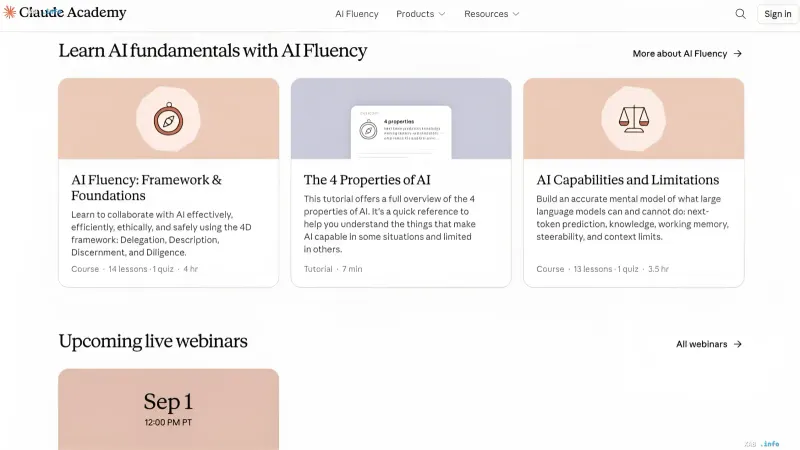
Anthropic, the developer of the Claude language model, has announced the launch of its official educational hub, Claude Academy (academy.claude.com). The platform is positioned not as an entertainment resource but as an infrastructural element of the company's strategy: it aims to bridge the gap between the computational capabilities of modern LLMs and the actual qualifications of users, shifting interaction with artificial intelligence from a dialogic chat format to the plane of systematic task delegation. At launch, the library includes more than 20 structured courses, over 100 step-by-step guides, a library of applied case studies, and a series of webinars; access is provided free of charge, without requiring payment details, making the initiative globally accessible on a mass scale.
Learning Architecture: The 4D Methodology Instead of "Magic Prompting"
The conceptual core of the platform is the proprietary AI Fluency methodology, implemented through the so-called 4D Framework. It shifts the focus from memorizing prompt templates to four measurable competencies: Delegation (conscious distribution of roles between the human and the model), Description (precise formalization of context and instructions), Discernment (critical verification of results, filtering out hallucinations, assessment of reasoning logic), and Diligence (ethics, cybersecurity, handling of sensitive data). From a corporate risk-management perspective, this is significant: Diligence effectively embeds into the curriculum requirements close to personal data processing norms and corporate information security standards, simplifying the deployment of Claude in regulated industries.
Product Trajectories: From Claude 101 to Multi-Agent Systems
The catalog is divided into independent tracks by skill level. For non-specialists and beginners, there is a basic track, Claude 101 (13 practical modules, approximately 2.5 hours), and the Claude Cowork section, which teaches orchestration and delegation of end-to-end multi-step tasks in marketing, analytics, HR, and operational processes. For engineers and architects, there are in-depth technical tracks: a foundational course on the Claude API (67 lessons and 8 practical tests, about 9 hours), the Claude Code module for development and debugging via terminal/CLI, as well as integrations based on the Model Context Protocol (MCP) and building multi-agent systems. This vertical effectively replicates within a free product the same product line that the company sells to enterprise clients.
Economic Model and Competency Verification
The platform's free access, combined with the issuance of named digital certificates and badges for completing key tracks, creates a model analogous to corporate academies of major technology players. For the market, this means the emergence of a standardized but informal "quality mark" for training in a specific ecosystem. Compared to paid bootcamps and online courses (typical range of $200–$1,500 and above), Claude Academy offers direct expertise from the creators of the model and the MCP architecture, rather than a secondary interpretation of documentation. For Anthropic, this is a way to lower the barrier to entry for the enterprise sector: employers receive a pool of employees who have already passed verification under the company's internal standards.
Macro Context: The Battle for the AI Interaction Standard
In the broader industry context, the launch follows the logic of the industry's transition from web chats to autonomous agentic environments. The key barrier to adoption here is not model power but user qualifications and tool compatibility. Free training of the mass market under MCP protocols and Claude Code CLI tools is a pragmatic step toward standardizing proprietary interfaces and building an "army" of specialists tied to the Anthropic ecosystem. The long-term consequence: if the 4D methodology and the MCP protocol become de facto industry norms, the company secures its role as a standards provider, not just a model provider, strengthening its negotiating position in the enterprise segment and in dialogue with regulators.
Contradictory Data
During fact-checking of the news, it was necessary to distinguish between two adjacent but distinct product launches. A number of publications (Forbes, MSN) covered the "AI for Teachers" / "Claude for Teachers" initiative (materials dated July 14, 2026), aimed at the educational segment and its influence on school curricula. This initiative is not identical to Claude Academy and should not be conflated with it when citing figures. In addition, the quantitative metrics of Claude Academy (20+ courses, 100+ guides, 67 lessons in the API track) are provided in materials related to the platform's launch itself and are not the result of an independent audit; the exact date of the hub's public opening is not consistently recorded in available sources. Both versions of the facts are presented for transparency, while the fact of the launch of a free educational hub is confirmed by several independent sources.
Conclusion: Claude Academy is not a social project but an infrastructural tool linking the educational, product, and corporate layers of the Anthropic ecosystem. Its significance goes beyond prompt training: the platform establishes the 4D methodology and the MCP protocol as foundational standards, builds a verified talent pool for the enterprise market, and strengthens the company's position in the competition for the dominant interface for human interaction with autonomous AI agents.