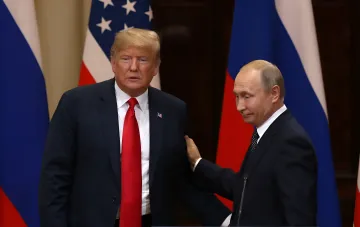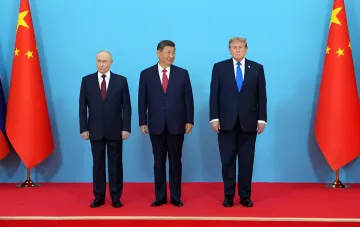
The trilateral meeting between the leaders of the US, China, and Russia on the sidelines of the Asia-Pacific Economic Cooperation (APEC) summit has been described by Estonian experts as a historic diplomatic event: for the first time, the heads of these three states held talks in such a format. At the same time, analysts emphasize that no concrete agreements were reached following the meeting. Rainer Sachs, security adviser to the Estonian presidential chancery, noted that achieving any specific goals was not initially planned — face-to-face bilateral talks between the countries were much more important.
Format over Outcomes: What Was and Wasn't Discussed
According to Sachs, the US and Russia wanted to briefly discuss the conflict in Ukraine, but China, in his assessment, was definitely not interested in this. "Perhaps the parties exchanged a few phrases on this topic, but no real negotiations on this issue took place," he explained. Parallel to the trilateral format, bilateral meetings were held: between the US and Russia, between Russia and China, and between China and the US. Thus, in the expert's view, the real substance of the summit's diplomacy lay not in a joint statement, but in a series of closed bilateral contacts.
Sachs: Putin Managed to Convince Trump of His Intention to End the War
The Estonian security adviser claims that Vladimir Putin managed to convince Donald Trump of his intention to end the war. «After such meetings, this always happens. I have no doubt that the Russian president is still capable of influencing the US president. Perhaps this is not so much about specific leverage to force him to take certain steps, but rather an attempt to convince the American president that Russia is interested in a peace agreement and genuinely strives for peace. Until now, the US president has accepted these statements quite uncritically. That is where the influence lies," Sachs stated. In his assessment, this very ability to shape the perception of the American leader is the essence of Russian influence in this context.
Kaljulaid: Trump Lost Influence — in Europe and the US
Riigikogu member Raimond Kaljulaid, by contrast, assessed the summit's outcome as a loss of influence for Trump both in Europe and the US. According to him, it is about "how he spoke, with whom, and where." «America has always wanted to portray itself as the most important, largest, strongest, and most influential player. However, now it looked as though he had come to a reception hosted by the Chinese leader. The meeting took place in China. And the atmosphere itself gave the impression that people had come to explain to Xi Jinping what they were doing and how they intended to solve global problems," the MP stated. Thus, Estonian analysts differ in their emphasis: for one, Putin's influence on Trump is key; for the other, the US's loss of its leading player image against the backdrop of the Chinese host.
Joint Declaration and the Context of the "Energy Truce"
Following the meeting of the leaders of Russia, the US, and China, a joint declaration was published, consolidating shared approaches to UN reform, the jurisdiction of the International Criminal Court — despite the fact that none of these countries recognizes the ICC's jurisdiction — and the reduction of nuclear risks. Additional context is provided by Estonian media reports citing Reuters: according to their data, the hidden motive behind a number of Trump's moves is to bring Russia back to the negotiating table, while the "energy truce" and the diesel fuel agreement are seen as tools to soften Moscow's conditions for ending hostilities. Against this background, reports indicate that the Ukrainian side stated that following the announcement of the "energy truce," the Ukrainian army did not attack energy facilities in Russia, whereas Russia, according to them, continued attacks on Ukraine's energy infrastructure.