Researcher Derick Kauffman has discovered a hidden catalog of words and phrases within iOS firmware that the iPhone keyboard intentionally avoids suggesting during swipe typing and auto-fill. By his conservative estimate, this involves roughly 100,000 words and permutations, some of which never appear in suggestions while typing. Kauffman published a detailed list of the discovered expressions and emphasized that this is not an outright ban: a user can manually type any word in a message or email, but the system deliberately avoids suggesting such phrases via predictive text. According to the specialist, most of the blocked items relate to profanity, sex, violence, and prohibited substances, but the list also includes politically colored formulations in various languages.
How the Researcher Stumbled Upon the Hidden Catalog
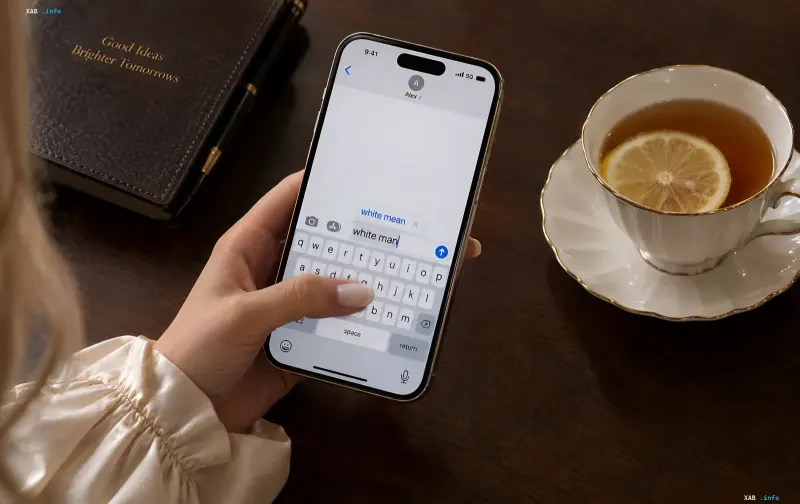
According to Kauffman, he noticed an anomaly when swipe typing kept "glitching" on certain phrases — for instance, "bad boy" or "white man" — while reverse or neutral combinations worked without issue. To figure out the cause, he used artificial intelligence tools, specifically OpenAI's Codex and Anthropic's Claude Code models, which helped locate encrypted files inside iOS. Journalists, in turn, tested some of the found phrases and confirmed the results: an attempt to swipe-type "white man" turned into "white mean", while instead of "Sleepy Joe", the system outputted "Sleepy hope". Cybersecurity engineer Matt Suiche independently verified the discovered data and confirmed its compliance with Apple's internal structures.
What Exactly Falls into the Keyboard's "Gray Zone"
According to the published list, a significant portion of the excluded combinations consists of crude profanity, insults, and mentions of narcotic substances. Among the recorded phrases subject to predictive text restrictions are "беспредел мусор", "белая мужлан", "выходец из Кавказа", "либерал болотная", "распили бюджет", "фильтровал базар", and others. The expert characterized the mechanism as "a soft form of censorship that, given the scale of Apple's operations, can quietly influence the communication style of millions of people." At the same time, as Kauffman emphasizes, this concerns the suppression of automatic suggestions rather than the blocking of manual text entry.
Political Slice: From Trump to Modi
A separate layer of the catalog consists of politically colored phrases in various languages. In the English-language segment, the system avoids suggestions like "dictator Trump" and "sleepy Joe". In French, the swipe typing of the phrase "immigration too high" is blocked, and in Hebrew, "occupied territories". In Hindi, the keyboard blocks critical remarks directed at Prime Minister Narendra Modi and his opponents. Other excluded expressions include "right wing conspiracy", "Tibetan independence", and "United Ireland". Thus, the filter affects not only profanity but also a range of topics considered politically sensitive in different countries.
Russian-Language Segment: 637 Entries
After analyzing the discovered catalog, it turned out that the list contains 637 entries in Russian. A significant part of this segment consists of crude profanity and swearing. At the same time, some of the blocked combinations relate to military themes and political contexts: particular attention was drawn to a mention of the Russian aggression against Georgia in 2008 in the form of the phrase "войн с Грузией". Also found in the list is a formulation mentioning the Russian president — "Путин прогнав" — the exact purpose of which, according to the researcher, remains unclear. In addition, various offensive expressions listed above fell under predictive text restrictions.
"Soft Censorship" and the Question of Transparency
The incident sparked a discussion about the boundary between protecting users from toxic content and technological transparency. Many users had previously noticed strange predictive text behavior, but the scale of such a list has become known for the first time. Electronic Frontier Foundation (EFF) Senior Staff Attorney David Green noted that to a certain extent, such an approach can be justified by combating unwanted or inflammatory prompts, but in his opinion, such algorithms should not remain secret: users should clearly know about the existence of restrictions and be able to configure them independently.
Apple's Position
Apple has not officially commented on the size or composition of the found list. The company limited its response to stating that keyboard settings are aimed at preventing inappropriate or offensive suggestions. Thus, the filtering mechanism is confirmed both at the level of independent technical verification and at the level of the developer's official position, while the exact volume and complete composition of the catalog remain a subject of research estimates.