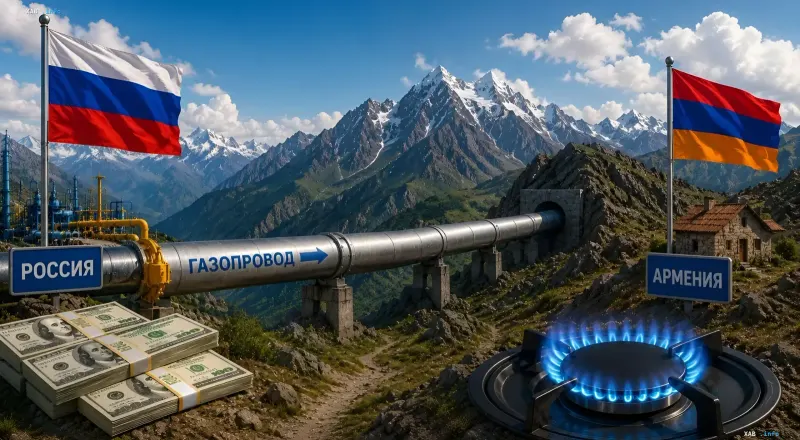
The geopolitical and energy split in the South Caucasus region has reached its sharpest and most irreversible point in history. Armenia has officially announced its complete readiness to abandon cheap Russian gas to protect its national interests and state sovereignty. Secretary of the Security Council of Armenia, Armen Grigoryan, in a statement to Verelk, voiced Yerevan's firm position on this issue, emphasizing that the country no longer intends to endure economic pressure.
Energy Blackmail and the Price of Sovereignty
He stressed that although the government has not yet received direct signals from Moscow about possible restrictions, it is ready for any development, including the search for alternative gas supply routes. Earlier, Russian officials openly reminded that if Armenia leaves the Eurasian Economic Union and turns toward the European Union, the preferential price of $177.5 per 1,000 cubic meters will be cancelled, and the gas price will increase 2–3 times.
Contradictory Data
While Yerevan declares its fundamental readiness to pay market prices for independence, Russian and independent experts warn of catastrophic consequences of such a step. According to analysts from various sources, a complete rejection of Russian fuel will be a significantly more painful shock for the Armenian economy than a similar rejection for major European countries, as internal infrastructure was tailored strictly to Russian supplies for decades.
Alternatives and New Risks
In response to such pressure, high-ranking officials made sharp statements that gas should not be measured by political tribute. Analysts recall that even after the peace agreement signed under pressure, Yerevan saw no positive shifts: Baku demands a change in the constitution, and border delimitation remains incomplete. The Iranian direction is considered as a possible alternative, but political realities make this path complicated.
Expert Assessments and Economic Consequences
Experts on the South Caucasus agree that the threat of an economic shock is quite real. A 2–3 fold increase in fuel prices could sharply accelerate inflation and increase utility bills for the population. However, the Armenian government views these costs as a necessary price for long-term security.