Ukrainian company ARMOLAB has officially introduced the new modular Unmanned Ground Vehicle (UGV) UNIMOD, designed specifically to meet air-dropping requirements. This was reported by RBC-Ukraine with reference to a publication by the developer on Facebook. The system features a modular architecture and is intended to address logistics and evacuation tasks in environments where conventional delivery of equipment is impossible or extremely difficult.
Modular architecture: three blocks instead of a single chassis
The key design feature of UNIMOD is the division of the chassis into three independent units: two tracked drive modules and a central platform connecting them. This scheme allows the complex to be transported in parts and assembled directly at the site of operation. In a demonstration video posted on the company's social media, developers show the assembly process and subsequent movement of the assembled vehicle over rough terrain. As envisioned by ARMOLAB, the UGV can be delivered by air drone either fully assembled or in separate modules, which significantly expands tactical options and reduces requirements for the payload capacity of delivery systems.
Technical specifications of the production model
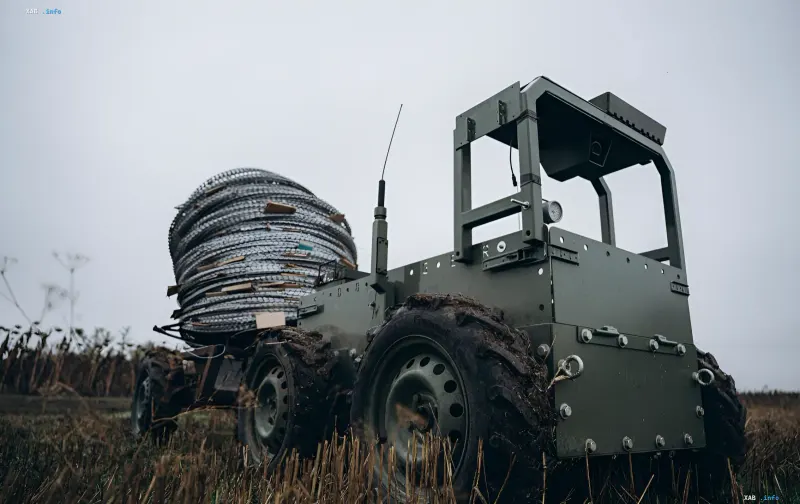
According to the manufacturer, the production version of the UNIMOD drone weighs about 59 kilograms, making it one of the lightest in its class of ground robotic complexes with such a high payload. The maximum speed is up to 6 km/h, and the stated payload capacity reaches 100 kg. The company also offers a wheeled chassis version, allowing the unit to be adapted for different surfaces and tasks. Among the main applications specified by the developer are logistics (delivery of goods, ammunition, medicine) and the evacuation of wounded personnel or troops from areas inaccessible to standard vehicles.
Airdropping as a core tactical function
The design of UNIMOD was originally focused on air delivery. The modular construction allows for overcoming restrictions on dimensions and mass imposed by the payload limits of transport drones or helicopters. In the context of combat operations, this means the capability to deploy the robotic unit into rear or flank positions without the need to clear routes for wheeled or tracked vehicles. Previously, as RBC-Ukraine recalls, the Third Army Corps conducted the world's first airdrop of a UGV from bombers into enemy rear lines, which confirms the relevance and demand for such solutions at the operational level.
Global context: modularity becoming the standard
The introduction of UNIMOD fits into the general global trend toward modular and reconfigurable ground robotic platforms. Recently, the Renault Group unveiled the Forefront Concept — a modular UGV created based on proven automotive technologies and components, with two electric motors, four-wheel steering, and a range of about 400 km on a single battery charge. In September 2026, the Croatian Komodo UGV, produced by Rheinmetall, underwent bridge-laying trials, demonstrating the expansion of ground robot functionality beyond traditional logistics. Thus, ARMOLAB's UNIMOD continues a development path where compactness, modularity, and the potential for air delivery are becoming defining requirements for the new generation of ground drones.
Prospects and practical significance
With a mass of 59 kg and a payload of 100 kg, UNIMOD enters the segment of tactical robots capable of carrying a load equivalent to the weight of two to three people, while remaining within the range of light aerial platforms. The availability of a wheeled version expands use scenarios: from delivery in conditions of destroyed infrastructure to operation on hard surfaces. For the Ukrainian side, where front-line logistics and the evacuation of wounded remain critical tasks, the appearance of a mass-produced modular UGV capable of airdropping is of practical interest to both armed forces and civil services in emergency situations. Future project development, including the integration of navigation systems, communication equipment, and weapon modules, will determine its place in the tactical arsenal.