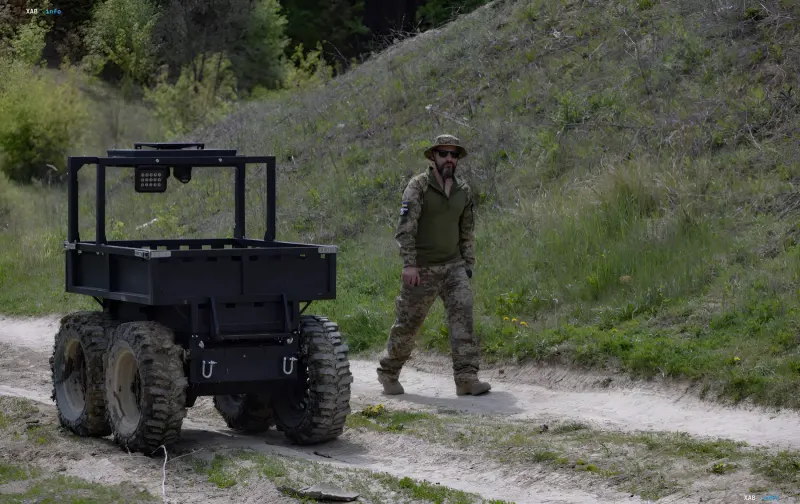
The Ukrainian Navy has reported its first-ever operation in which a ground-based kamikaze robotic complex was delivered by air to the occupied left bank of the Dnipro River and used to destroy a position of Russian drone operators. RBC-Ukraine reports this citing an official Navy statement. The operation was carried out by the 426th Unmanned Systems Regiment: a platoon of ground robotic systems (GRS) acted in coordination with FPV drone crews, bomber drones, and reconnaissance UAVs, allowing a multi-stage attack to be conducted without deploying personnel to the opposing territory.
Delivery Across the River: How the Robot Crossed the Dnipro
Air delivery became the key link in the operation. According to the Navy, the "Perun" UAV transported a kamikaze GRS with a 7-kilogram combat payload to the left bank of the Dnipro. The military emphasizes that the robot landed without losses: controllability and the communication channel with the operator were fully preserved after landing. This is fundamentally important for such operations, as any degradation of telemetry at the landing stage would make further autonomous movement of the complex impossible. The use of a heavy transport and towing UAV to transfer a ground robot across a major water barrier demonstrates a new level of integration of air and ground drones into marine tactics.
Battle on the Route: Robot as Scout and Target for FPVs
After landing, the GRS independently began moving along a predetermined route. Along the way, from the robot's onboard systems and from the air, the military detected enemy positions, and each of them was immediately struck by FPV drones. Thus, the ground complex performed not only the function of a warhead "carrier," but also served as a mobile reconnaissance node exposing targets for strike drones. The final point of the route was the entrance to a building where, according to the Ukrainian military, Russian UAV operators were stationed. When a fighter emerged from the door, the operator armed the robot, and the position was additionally struck by an FPV drone. The Navy reported that all stages of the operation were video-documented, and there were no casualties among the Ukrainian military.
The case of delivery across the Dnipro is not a one-off experiment, but part of a broader trend: the Ukrainian military is increasingly using ground robots in non-standard environments. In particular, the "Charter" brigade for Operation Veles in the Kupiansk direction developed unique GRS adapted for combat in narrow underground gas pipelines. The combination of these examples indicates that ground robotics is ceasing to be an auxiliary tool and is becoming a full-fledged tactical element capable of operating in conditions where a classic deployment of personnel carries unacceptable risks.
For further assessment of such operations, it is important to monitor how stable the communication and control channels of ground complexes prove to be when working in remote and rugged areas, and how the enemy will react to the appearance of aerial "taxis" for delivering robots across water barriers. Meanwhile, according to the Navy statements, the demonstrated scenario worked in full and was documented on video.