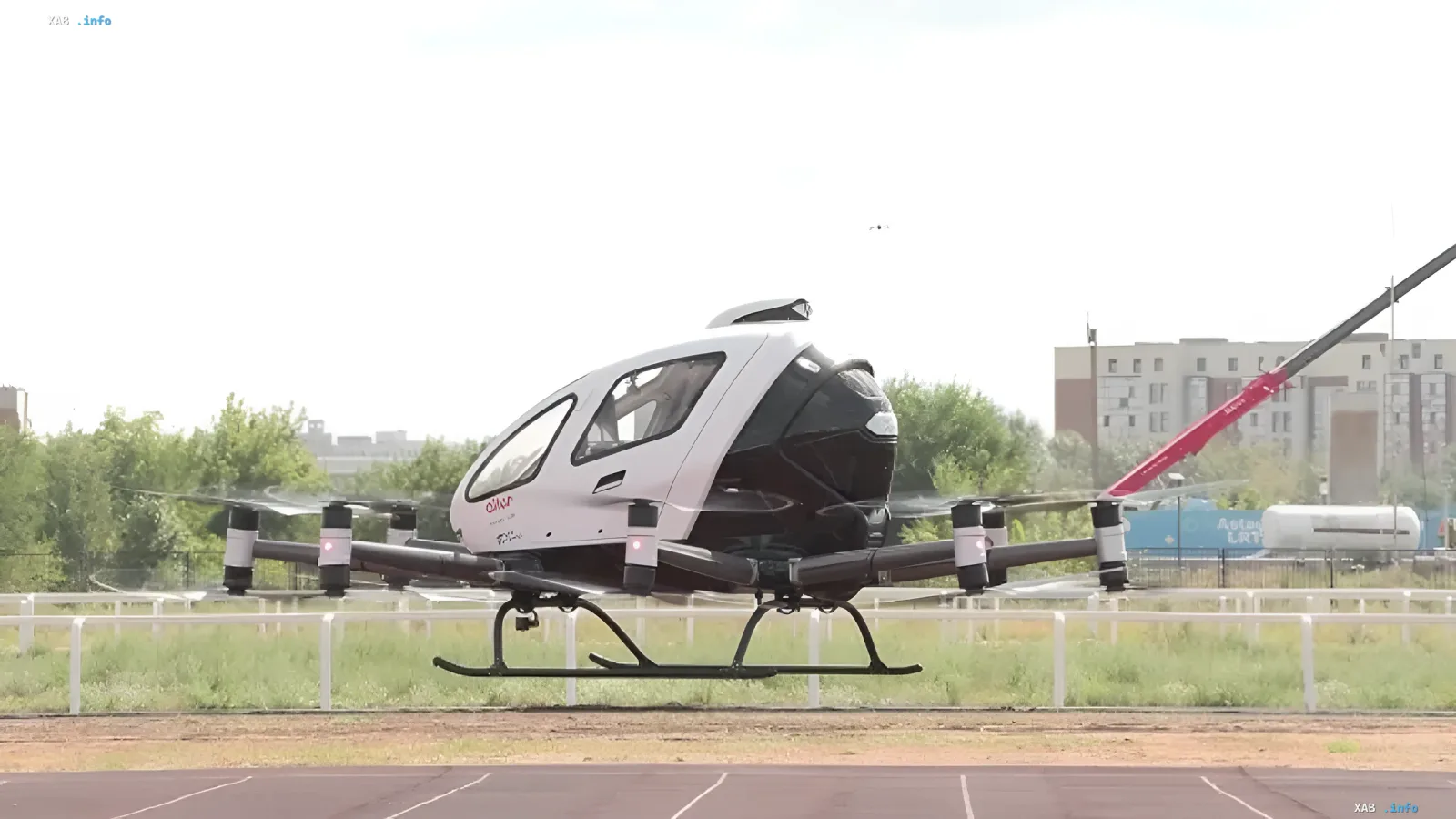
Historic breakthrough in the capital's transport system
On August 9, 2026, Kazakhstan took a significant step in developing the transport infrastructure of the future. In Astana, for the first time in the country's history, an unmanned aerial vehicle with a passenger on board completed a flight. This event was part of the international tournament "Future Games — 2026," held in the capital to showcase cutting-edge technologies from around the world. The flight was carried out by an electric vertical take-off and landing (eVTOL) aircraft, model EH216-S, developed by the Chinese company EHang. The test took place over a specially designated area within the city limits and confirmed Kazakhstan's readiness to implement innovative solutions in the field of urban mobility.
Technical specifications and potential of eVTOL
The EH216-S aircraft is designed to carry two passengers simultaneously. It can reach speeds of up to 130 kilometers per hour and travel distances of up to 35 kilometers without a pilot. These characteristics make it an ideal solution for short flights within large cities or between neighboring settlements. The Ministry of Transport of the Republic of Kazakhstan emphasizes that this test was the first verification of such technology under real conditions in the country and demonstrated the capabilities of unmanned passenger transport.
Plans for integration into the urban environment
The government is considering the possibility of launching demonstration and tourist flights lasting from 5 to 30 minutes over Kazakhstan's natural, cultural, and historical landmarks. In the future, such air taxis could become part of the urban transport system and complement existing modes of transport. New technologies are planned to be used not only for passenger transport but also in emergency medical services, medicine delivery, search and rescue operations, firefighting, and logistics. This opens up broad prospects for the application of eVTOL in various sectors of the economy and social sphere.
Production localization and regulatory framework
One of the key directions of the project is the localization of the production of passenger unmanned aircraft in Kazakhstan based on international cooperation. It is expected that this will contribute to the creation of new high-tech production capacities and additional jobs, as well as the expansion of industrial cooperation. As reported by the Ministry of Transport, the necessary regulatory framework for the implementation of urban air mobility has also been established. Relevant amendments have been made to the legislation concerning eVTOL air taxis, vertiports, and unmanned air traffic management systems. This creates favorable conditions for the further development of the industry and the attraction of investments.