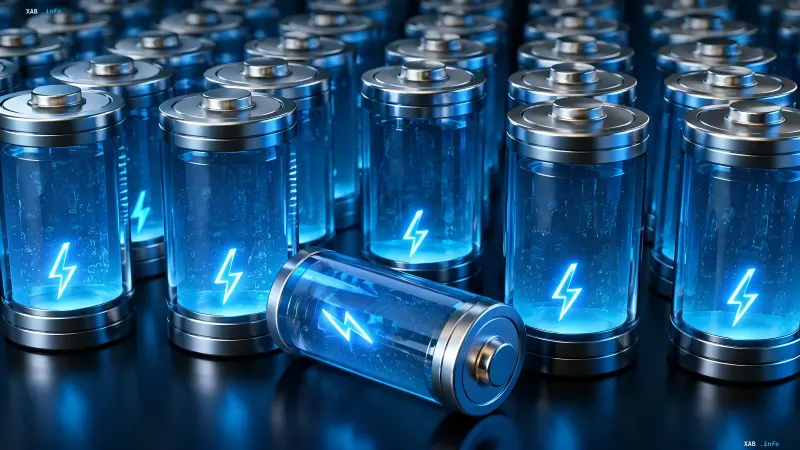
Researchers at Flinders University (Australia) have presented a prototype aqueous zinc-iodine battery that, according to laboratory data, can withstand more than 60,000 charge-discharge cycles and fully charges in just three minutes. According to Iksbt.com, the development is considered a significantly safer and cheaper alternative to common lithium-ion batteries in the energy storage systems market. The key difference of the novelty is a non-flammable water-based electrolyte and the use of zinc, which is an abundant and relatively cheap raw material.
Technology and Suppression of the “Shuttle Effect”
For a long time, aqueous zinc-iodine systems were held back by one fundamental flaw: iodine compounds migrated through the separator between the electrodes — the so-called “shuttle effect.” This process led to a gradual loss of active material and a deterioration of battery performance over time. The Flinders University team stated that in the new design it was possible to suppress this migration, which ensured the record resource and high charging speed. It was precisely the solution to the shuttle-effect problem that became the central result of the work, moving the technology from the category of laboratory curiosities to that of potentially competitive energy storage devices.
Laboratory Test Results
During testing, the battery demonstrated a capacity of about 200 mAh/g and withstood more than 8,000 cycles with a charging time of seven minutes. When the working capacity was reduced to 150 mAh/g, the charging time was cut to just three minutes, and the resource exceeded 60,000 cycles. The degradation rate of the cells was only 0.0001–0.0003% per cycle, and the operating voltage was in the range of 1.3–1.4 V. Such figures make the cell attractive for scenarios where longevity and fast recharging are important — from backup power to integration with renewable energy sources.
Contradictory Data
In the description of the technology in different sources there are discrepancies in emphasis. The main text (Iksbt.com) characterizes the development strictly as an aqueous zinc-iodine system and does not mention organic components. At the same time, the publication Zamin.uz (19.08.2026) presents the same Australian development as a “eternal” battery based on starch. The most likely explanation is that starch is used in the composition of the separator or electrolyte precisely to suppress iodine migration, that is, it is part of the solution to the shuttle-effect problem, and not an independent active material. Nevertheless, until the full text of the scientific work is published, the exact role of starch in the design could not be confirmed, and editors should consider both descriptions as complementary rather than mutually exclusive.
Strategic Significance for Australia
The development has special strategic significance for Australia, which, according to estimates, holds about 20–28% of the world's zinc reserves. The use of local raw materials will reduce dependence on global supply chains of materials for lithium-ion batteries and create conditions for the development of its own production of energy storage systems. For a country actively developing the “green” energy sector, this is a potential way to secure a niche in the market of next-generation storage devices.
The Path to Commercialization
At the current stage, the Flinders University team is closely collaborating with industrial partners on creating a platform for prototyping these batteries. To bring the technology to a commercial level, further scaling and testing of full-size devices will be required: laboratory cells still need to be turned into industrial assemblies with proven reliability under real operating conditions. Experts emphasize that the stated 60,000 cycles and three-minute charging were obtained under controlled laboratory parameters, and their retention at industrial scale will be a key question in the coming years.