
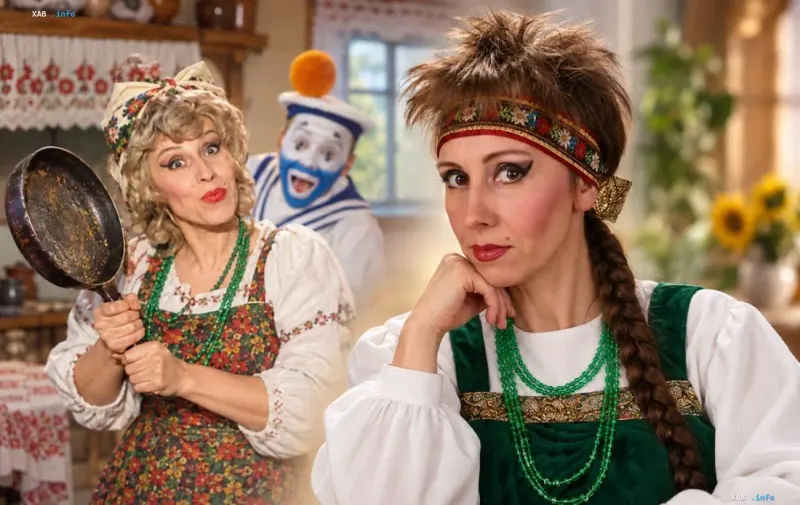
In the 1990s, Tatyana Ivanova was one of the few women regularly seen in popular humor projects on Ukrainian television. Her greatest recognition came from her role in 'Kalambur' — a humor magazine show that first aired on October 12, 1996. It was there that the actress created the image of the Baba from the 'Village of Fools' segment, a character that, decades later, remains the thing audiences most associate with her name. By October 2025, Ivanova turned 60, and today she leads a largely private life, though she has not left the stage entirely.
How 'Kalambur' Was Born
The show premiered on October 12, 1996. It was not a classic sitcom but a kind of humor magazine made up of several segments: 'Nose Dive', 'Kalambur Bar', 'Iron Kaput', and 'Village of Fools'. In different parts of each episode, the actors created completely different characters, so viewers could see the same performer in several roles within a single broadcast. The 'Village of Fools' segment held a special place, home to the Man, the Baba, the Sailor, the Bear, and the Bee. The characters barely spoke: the humor was built on facial expressions, gestures, exaggerated reactions, and comic situations, while the images stuck in memory thanks to their distinctive behavior and visual details.
The Baba from 'Village of Fools'
Ivanova's signature role was the Baba — the Man's wife. The character was emotional, impulsive, and highly recognizable, and one of her recurring comic props was a frying pan. The sketches used characteristic stereotypical details — a bear, a samovar, a balalaika, alcohol, the image of a simple-minded man, and rural life. Because these traits were exaggerated, the characters turned into caricatures, and today it is precisely this segment that is often recalled as an example of humor in which Ukrainian writers played on the recognizable image of so-called rural Russia. At the same time, 'Kalambur' itself was broader than a single segment: it mocked various everyday situations, human temperaments, and social types. Notably, the show was created by Ukrainian performers, and it was later broadcast on Russian television as well.
The Only Woman in the Cast
Among the main actors of 'Kalambur', Ivanova was the only woman. Before the show appeared, she had already been performing alongside Sergei Gladkov and Vadim Nabokov in the trio 'Magazin Fu', and then joined the core cast of the new project. Besides the Baba, the actress appeared in other sketches — in particular, playing a waitress and a flight attendant — but it was the female character from 'Village of Fools' that became her calling card.
After 'Kalambur'
After the television run of 'Kalambur' ended, Ivanova did not stop acting: she appeared in Ukrainian and Russian-language TV projects and worked in theater. Among her later works are the series 'Odessa Mama', 'Anka from Moldavanka', 'Maestro', and others. In 2019, the actress reunited with her 'Kalambur' colleagues in the project 'Ivanova-45', and the following year the ensemble members took to the stage with a concert program. In recent years, Ivanova has appeared on screen far less often and leads a private life.
Personal Life
Tatyana Ivanova was born on October 4, 1965, in Odesa. Her husband is the actor Vadim Nabokov, with whom she worked even before 'Kalambur'. The couple has two children — a son, Ilya, and a daughter, Maria. Despite the many years that have passed, it is the Baba from 'Village of Fools' who remains the role audiences most often associate with the actress.
Contradictory Data
In publications about the actress, there is an inconsistency in the name of the most famous segment: in some materials it appears as 'Village of Fools', in others as 'Settlement of Fools'. In essence, both refer to the same storyline and the same image of the Baba, yet the sources use both spellings in their texts. It is also worth noting that the exact chronology of the later joint projects with her 'Kalambur' colleagues (in particular, the concert program dated 'the following year' after 2019) is presented with varying levels of detail in open sources, so it is recommended to rely on primary sources when citing.