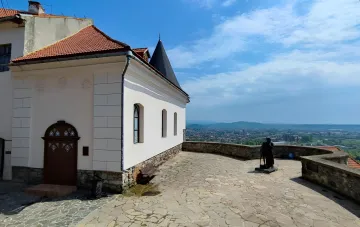
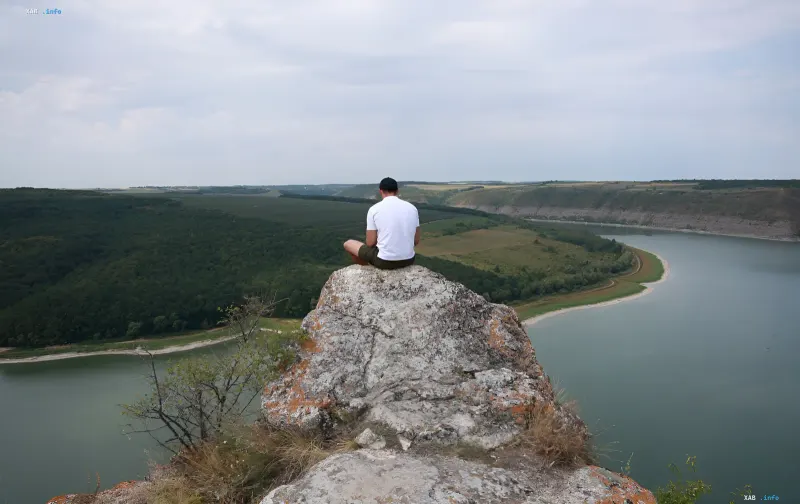
Ukraine has launched the national program “A Journey to Yourself. Paths of Recovery,” whose idea is to show that traveling within the country can be a way to restore your strength, spend time alone with yourself, and rediscover places that seem familiar only at first glance. A correspondent for Wave magazine took part in a promotional tour of Podillia and shared how to “reset” in this region. The central point of the route is Bakota, one of the region's most famous tourist destinations: the winding Dnister “cuts through” the hills, and the bay's water surface covers more than 1,500 hectares.
A flooded village and “history in the water”
Just half a century ago, Bakota was a living village with an ancient history in the Dnister valley. When the hydroelectric power plant was built, the valley was flooded and turned into a bay. “Along with Bakota, nearly three dozen other villages were flooded. No one could have imagined that the water would rise 40 meters here, but the Soviet Union needed to build yet another hydroelectric plant,” says Ihor Vyshemirskyi, the chief specialist of the general department of the Staroushytsia hromada. On the road to Bakota, the village's past is recalled only by a bus stop standing in its original place: today it is an improvised museum featuring Podillia painting, photographs, and documents belonging to the residents of Bakota — passports, labor-day records, and lists of the deceased. In these places you can still meet long-time residents who became eyewitnesses to the flooding.
A cave monastery and an ancient spiritual center
The region's tourism slogan — “History in the water, soul in the rock” — captures the essence of the place: the past of the villages has gone under the water, but here an ancient spiritual center of Pohnizhia has been preserved — a cave monastery of the 11th–15th centuries, carved into the White Mountain, which rises 120 meters above the waters of Bakota. “This used to be a place of pagan worship: during excavations on the shore, a carved footprint on stone, stone statues, and altars were found. And it was only in the 11th century that monks came here. The double-sided cross-encolpion found during the excavations proves that Bakota was then a spiritual center,” explains Taras Horbatiuk, a worker at the Podillia Tovtry National Nature Park. Today the monastery is not active, but it has the status of a monument of national significance: visitors can enter the caves, and the faithful leave prayer notes before the icons.
Contradictory data
Among tourists, it is widely claimed that under the waters of Bakota you can see the ruins of a flooded church and even crosses on graves. However, local residents and specialists whom the correspondent spoke with call these stories tall tales: according to them, everything was destroyed before the flooding, and the ruins were not preserved underwater. Thus, the version of “ruins visible from the water” contradicts the testimony of long-time residents and park workers, and in reality no such objects are observed in the bay.
Glamping by the water: prices and conditions
The Bakota bay is increasingly attracting tourists with the opportunity to relax by the water. Since this is a protected natural area, large-scale resort complexes are prohibited from being built on the shores, but glamping sites are already operating here. The tent-cabins have beds and electricity, while the shower and toilet are located separately; the conditions are simple, but around is almost wild nature. A three-person tent at the “Prozori” glamping site costs from 2,500 UAH per day, and it is better to book places in advance for the season — finding available options for autumn is already difficult. Among the attractions are swimming in the bay, and paddling on SUPs and boats. It is important to note that mobile internet barely works here, and the connection sometimes drops — this is worth knowing for those who do not want to lose contact with civilization completely.
How to get there and what else to see
The most convenient way to get to Bakota is by your own transport or on a tour from Kamianets-Podilskyi. The bay's viewing platform and the monastery are located within the national park; the entrance costs 100 UAH for adults and 50 UAH for children. To learn how people used to live in this region, you can visit the museum in the neighboring village of Hrushka: in a hundred-year-old hut, the local way of life and items telling the culture of the Dnister surroundings have been preserved, while tours are conducted only for groups, cost 800 UAH, and require prior arrangement. In Hrushka, one of the oldest springs in the region, about 700 years old, has been preserved, and on the central street you can see a mural based on the work of Podillia artist Oleksandr Hrem.