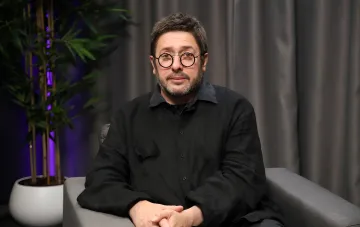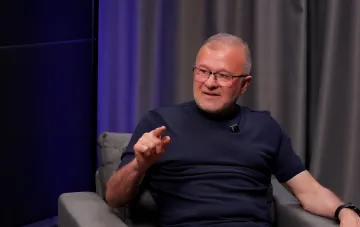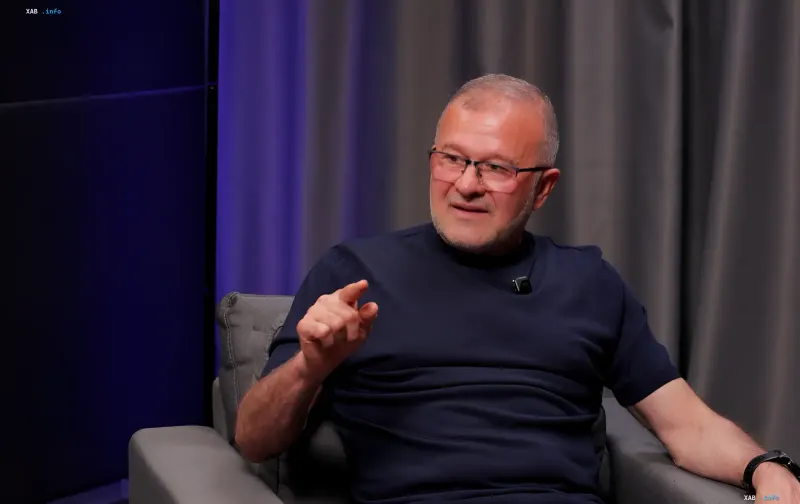
To mark the 35th anniversary of Ukraine's independence, RBC-Ukraine continues its special project "Ukraine: 35 Years of Independence" — a series of candid conversations with the people who made key decisions at critical moments of modern history. In the latest episode, the floor is given to Viktor Baloga, head of the President's Secretariat in 2006–2009, former head of the State Emergency Service, and a people's deputy for several terms. In an interview with Volodymyr Kurennoy, he spoke about the infighting within the "orange" team, the split with Yulia Tymoshenko, a secret report on Vladimir Putin's intentions, and for the first time revealed details of how, in his words, Ukraine lost the Tomos and the patriarchate in 2008 because of a single phrase.
Romantic Afterglow and "Everyday Life": How the Team Was Formed
According to Baloga, to understand what went wrong in the Yushchenko era, one needs to go back to 2004. The president, having not yet formulated a political slogan, began assembling a team that, in the interviewee's assessment, included both the entire left and the entire right spectrum. "He wanted to unite what is not united in the civilized world. On the Maidan tribune, Moroz stood next to Kinakh and the right-wing radicals," Baloga recalls. In his version, had Yushchenko started over, he should have taken only Poroshenko and Tymoshenko as partners, and then appointed Poroshenko prime minister. Baloga calls the appointment of Tymoshenko as prime minister a political mistake that laid the groundwork for conflicts within the team for years to come.
Personal or Ideological Conflict with Tymoshenko
Baloga characterizes the confrontation between Yushchenko and Tymoshenko as a combination of both a personal and an ideological conflict. He describes Tymoshenko as a person of left-wing, populist views, seeking to "have everything and immediately," whereas Yushchenko, in his words, was a right-wing politician and a strategist who saw the country's development in terms of language, history, and national identity. Baloga also criticizes the decision to hand the premiership back to Tymoshenko after the 2007 snap parliamentary elections, when, in his assessment, there was a chance to install a compromise figure. After that, in his words, came the "fight to mutual destruction over the 2010 mace," during which Tymoshenko was ready to go for constitutional amendments that would turn Ukraine into an analog of the Czech Republic or Poland.
The "Broad Coalition" and the Dismantling of Power
In response to a question about the real negotiations between Tymoshenko and Yanukovych, Baloga claims that Yanukovych, having obtained the premiership in 2006, set about dismantling Yushchenko from day one. In his words, thanks to Ivan Plushch's position, Volodymyr Shapoval's legal vision, his own coordination, and Rinat Akhmetov's position — who persuaded Yanukovych to go for snap elections — this plan was thwarted. Baloga notes that the president's family was ready to surrender, but the team insisted on snap elections. (In the provided interview fragment, this block is cut off and contains no further details.)
The Lost Tomos and the Poisoning
In the course of the interview, Baloga also touched on the topics of Viktor Yushchenko's poisoning and Ukraine's loss of the chance for a Tomos in 2008. In his version, a key role was played by a single demand of Yushchenko's, which, he claims, provoked a sharp reaction and led to the breakdown of the process. The full details of these statements are available in the full video interview on RBC-Ukraine's YouTube channel; the print version presents an abridged version of the conversation.
Contradictory Data
The provided materials show an inconsistency in the spelling of the interviewee's surname: the main text and the headline of source 1 use the variant "Baloga," whereas the headline of source 2 uses "Baloga." In addition, the print version of the interview is abridged and contains a fragment cut off in the block on the "broad coalition," so some statements (including those on the role of specific individuals in thwarting Yanukovych's plan and on the "single phrase" that cost the Tomos) are presented as the memoir assessment of a single source and are not corroborated in this material by independent confirmations. Readers should bear in mind that this concerns the subjective recollections of a participant in the events.