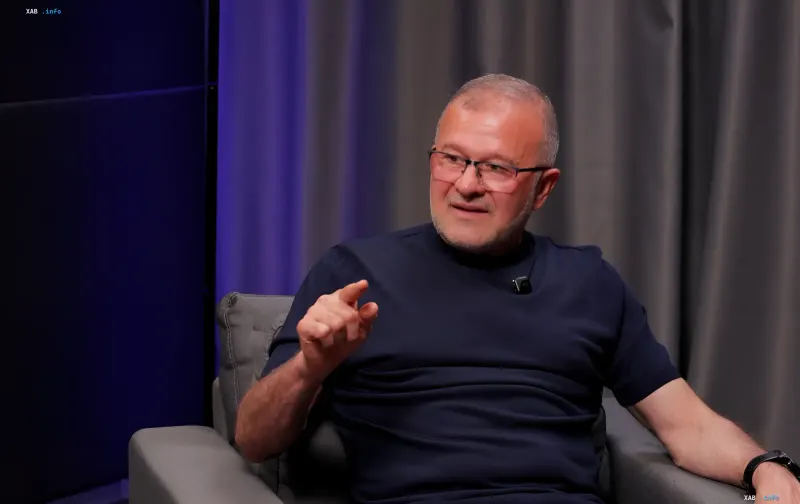
Former head of the President's Secretariat of Ukraine (2006–2009) Viktor Baloga, in an interview with RBC-Ukraine prepared as part of a special project marking the 35th anniversary of Independence, revealed his version of one of the most high-profile political crimes in the country's recent history. According to him, the poisoning of presidential candidate Viktor Yushchenko during the 2004 election campaign was the result of actions by his closest inner circle, which, in Baloga's assessment, acted in the interests of foreign intelligence services against the backdrop of a fierce geopolitical confrontation.
Baloga's statement: the inability to assess people critically
The former head of the Secretariat emphasized that he has "a complete understanding of exactly how this crime was prepared and carried out." In his view, the main precondition was that the perpetrators were able to infiltrate the presidential team because of Yushchenko's own inability to critically assess the people around him. It was precisely this, according to Baloga's version, that opened the way for the preparation of an assassination attempt on the candidate in the heat of the presidential race.
A name is named: Dava Zhvania
In response to a direct question about the specific individuals involved in the poisoning, Baloga named one of Yushchenko's closest allies — Dava Zhvania. This is one of the first public references to a specific figure from the candidate's inner circle in the context of the dioxin case. At the same time, Baloga stressed that, in his assessment, a global struggle between the West and the East stood behind the attempt to eliminate Yushchenko, and the perpetrators' ultimate goal was the physical destruction of the politician.
Geopolitical context and a personnel “purge”
According to Baloga, after the election victory, "businessmen and dubious figures" entered the governing team, which forced him, in his role as head of the Secretariat, to carry out a large-scale personnel "purge." This assessment allows the poisoning case to be linked to the broader process of forming the presidential team and the struggle for influence within it in the early years after the "orange" revolution.
Contradictory data
It is important to note that Baloga's statements represent his personal version of events, voiced in an interview more than 20 years after the poisoning. The official investigations into the dioxin case were not concluded with a verdict against specific perpetrators, and in the public domain there have historically been several versions — ranging from the actions of the closest inner circle to the involvement of intelligence services. Baloga's reference to Dava Zhvania as being involved has not been confirmed by a court decision and is not the subject of a court-proven charge. Thus, the fact remains the poisoning itself and the detection of a critical concentration of dioxin in Yushchenko's body, while the specific names of the perpetrators and their motives remain a matter of public statements and assessments by participants in those events.
Historical background: the dioxin case
Recall that the poisoning of Viktor Yushchenko took place in the autumn of 2004 during the presidential race. A critical concentration of dioxin — a highly toxic substance — was detected in his body. Despite the severe consequences for his health, Yushchenko won the election, however, the case of his poisoning remained for the following years one of the most high-profile and not fully solved in Ukraine's recent history.