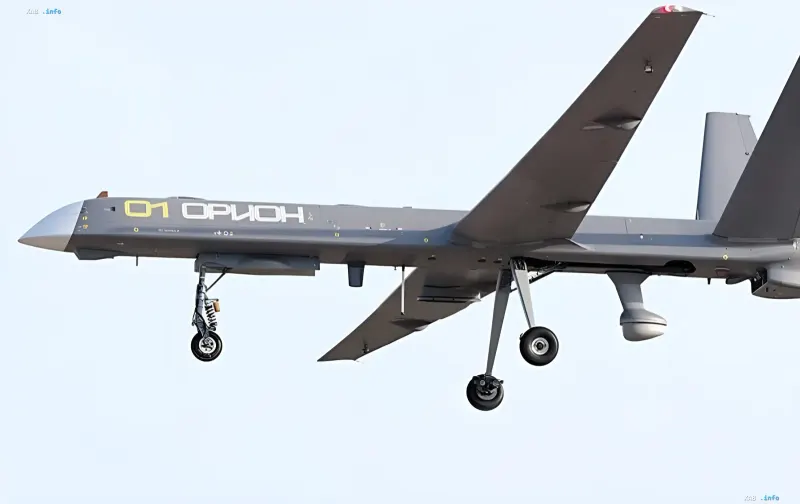
Serviceman of the 413th SBS Regiment "Raid" and Defense Express weapons expert Ivan Kyrychevskyi, speaking on the RBC-Ukraine podcast "TSE BAZA", suggested revising the classification of Russian strike assets "Banderyol" and "Dan-T". In his assessment, these items should be regarded not as modifications of Iranian Shaheds, but as full-fledged small cruise missiles with a takeoff weight of 260 kilograms, of which 130 kilograms account for the warhead. The expert emphasized that these items do not suffer from flight aerodynamics issues, and high-energy fuel provides a range of up to 500 kilometers. Kyrychevskyi also noted that the "Banderyol" can be mounted on the Mi-28 helicopter, which fundamentally distinguishes it from loitering munitions of the Shahed type.
Geran-2, Harpia-1A, and the gasoline Shahed: how the Russian military-industrial complex labels its products
Kyrychevskyi explained that the Russian military-industrial complex formally considers Geran-2 and Harpia-1A to be different products, but for Ukraine, they are effectively the same gasoline-powered Shahed. According to his data, products manufactured in the "Alabuga" zone are labeled as Geran-2, while items from the Izhevsk Mechanical Plant "Kupol" receive the designation Harpia-1A. The expert added that Harpia-1A is exported to Africa and used by units of the "Africa Corps". This indicates that the Russian military-industrial complex is building an elaborate labeling system where the same product goes to the domestic market and export under different names.
Where did the technology come from: purchase, copying, or Ukrainian samples
For comparison, Kyrychevskyi cited data on the LMUR missile, which Russian developers previously created for the Mi-28: a takeoff weight of about 105 kilograms with a 15-kilogram warhead. According to him, creating a small cruise missile where half of the takeoff weight is the warhead and which flies stably at the same time is an extremely difficult task. That is why, in the expert's opinion, Russia could have purchased the technology from a third-party supplier or "borrowed" solutions from Ukrainian samples. At the same time, Kyrychevskyi refused to name a specific supplier, noting that it is not necessarily China. He also recalled "Products 715 and 720" — missiles demonstrated at the MKB "Raduga" plant during visits by the Russian military-political leadership approximately in 2023–2024, indicating that the Russian Federation has its own groundwork in this niche.
Scale of use: 350 launches per month and the air defense problem
Yurii Ihnat, Head of Communications at the Air Force Command of the Armed Forces of Ukraine, stated in the same podcast that Russian troops used about 350 units of "Banderyol" and "Dan-T" over the course of a month. According to him, this is about ten times less than the jet drones that Russia uses for attacks on Ukraine. Ihnat suggested classifying such assets as drone-missiles or loitering munitions launched from airborne platforms. Kyrychevskyi, in turn, noted that when a sufficient quantity of strike assets is available, the characteristics of the missiles themselves take a back seat: shooting down everything completely is impossible, and air defense efficiency, according to partners' practice, turns out the same, but with costs orders of magnitude higher than the value of the intercepted targets.
A challenge for Ukraine's military tech sector: 10,000 engines per month
Kyrychevskyi recalled that Defense Minister Yevhen Khmara publicly stated the need to produce 10,000 engines of the same type per month next year. The expert called this a serious challenge for Ukraine's military technology sector. As a benchmark, he pointed out that American developers have been working on small jet engines since 2023, including 3D-printing rocket engines. Among the American analogues to the "Banderyol", Kyrychevskyi named the Rusty Dagger missile, which was supposed to be supplied to Ukraine, as well as the Barracuda family from Anduril. These examples, in his opinion, demonstrate that the technological race in the segment of small cruise missiles and loitering munitions is reaching a new level, and Ukraine is forced to respond to it both in terms of interception and its own production of counteraction means.