The U.S. Army Combat Capabilities Development Command (DEVCOM) has announced successful tests of an experimental unmanned aerial vehicle equipped with a power plant manufactured using additive manufacturing technologies. As reported citing an official U.S. Army statement, researchers have developed an advanced heavy-fuel rotary engine as part of a new research program aimed at overcoming key limitations of modern UAVs regarding range, payload capacity, and autonomy.
Hybrid Architecture: Rotary Engine and 400-Volt System
According to the U.S. Army, the new power plant is a series-hybrid system in which a heavy-fuel rotary engine is integrated with a 400-volt electrical subsystem. This configuration, developers state, is designed to support vertical takeoff and landing (VTOL) operations in challenging environments. The engine-generator included in the unit converts the mechanical energy of the rotary engine into electrical energy, allowing power to be flexibly distributed between traction circuits and onboard consumers.
Computational Fluid Dynamics and 3D Printing as Key Tools
Program manager Chol-Bum Kweon explained that to solve the challenges of efficient heavy-fuel combustion in the rotary engine, researchers applied advanced computational fluid dynamics modeling. As a result, the fuel spray and vaporization system was improved, and compressed air and fuel vapor leaks were minimized—factors that traditionally reduced the efficiency of such units. Using 3D printing to manufacture power plant components allowed for complex geometric shapes of channels and chambers unattainable with traditional machining methods, directly impacting the engine's aerodynamic performance.
Program Goals: Autonomy, Altitude, and Payload
«The program addresses critical power and propulsion problems, which should allow drones to fly longer and faster, operate at higher altitudes, carry larger payloads, and perform in extreme environments,» Kweon stated. Transitioning to heavy fuel, unlike light aviation gasolines, expands logistical capabilities: such fuels are easier to store and transport in field conditions, and their energy density is higher. This is especially relevant for tactical UAVs that must operate disconnected from baseline infrastructure.
Technology Transfer to Military Partners
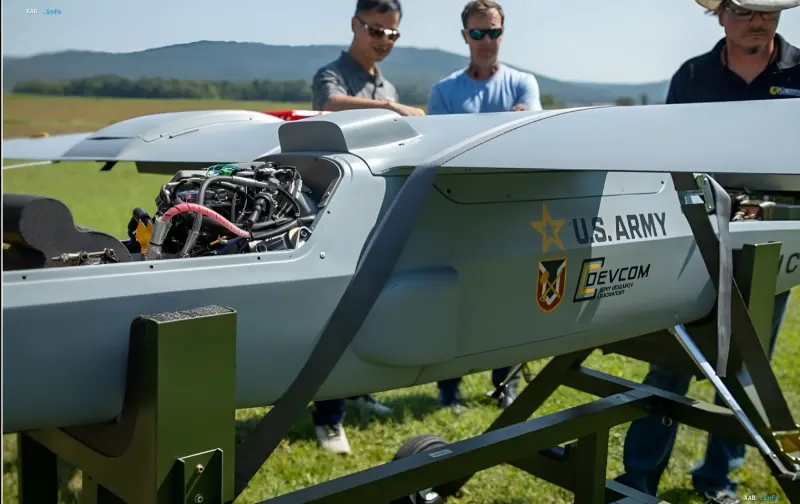
The U.S. Army statement notes that the new drone will be provided to military partners for further experiments and joint developments. This indicates Washington's intention to extend the program's results beyond internal testing and involve allies in refining the platform. Published footage shows the gray UAV fuselage marked with «U.S. ARMY» and the DEVCOM logo, mounted on a green metal frame in a field setting; the upper cowling is removed, exposing a complex bundle of piping, wiring harnesses, and rotary engine components typical of prototypes at the ground-testing stage.
Context: Technology Race in the Strike and Reconnaissance UAV Segment
The development of hybrid propulsion systems for drones has become a priority direction for several militaries against the backdrop of active drone use in modern conflicts. Increasing flight duration and payload capacity directly expands the tactical operating radius of UAVs and allows them to carry heavier payloads—from reconnaissance systems to strike munitions. The DEVCOM program fits into the broader context of U.S. Army efforts to create a new generation of tactical unmanned systems capable of operating in environments where traditional aviation and ground vehicles are limited in use.