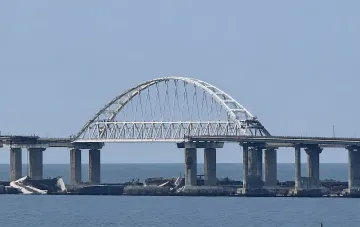
In the RBC-Ukraine podcast "THIS IS BASE" (ETO BAZA), volunteer, veteran, and Victory Drones project head Maria Berlinska commented on the strike against the Crimean Bridge and assessed future scenarios of the conflict. According to her, the operation is both symbolic and effective: it strikes at "imperial complexes" and effectively isolates the peninsula's overland logistics. At the same time, Berlinska does not believe this strike will force the Russian side to stop — rather, the conflict will continue along the logic of mutual exhaustion, in which, by her estimate, Ukraine has no right to take a pause.
Isolating logistics: what the bridge strike achieves
Berlinska emphasizes that after the bridge was struck, the main overland corridor to the peninsula was cut off: only unsystematic and sporadic ferry crossings remain, while Ukrainian crews and "mid-strikes" further complicate logistics. She calls this real, rather than merely symbolic, effectiveness of the operation, noting that "Moscow will fall through Crimea." At the same time, she states directly that the threat to Ukrainian bridges and energy infrastructure has not disappeared anywhere, so one should not expect the enemy to "calm down" after a single operation.
"All-in" and the race of attrition
Separating "wishful thinking" from reality, Berlinska believes that no single operation will become a reason for Moscow to stop: "the stakes are too high." In her estimation, the Russian elites, realizing they started a war they cannot quickly win but cannot afford to lose, are ready to pay any price and "go all-in" to survive. The key fear of the elites, as she phrases it, is internal collapse and the redirection of accumulated hatred against themselves, which, she says, makes stopping more dangerous for them than continuing escalation.
Why Ukraine cannot stop
Berlinska describes the asymmetry of positions: if Russia stops, the war stops, but if Ukraine stops, "Ukrainians will end." That is why, according to her, Kyiv is forced to hold the frontline and the defense industry, even with the readiness to cease hostilities on the day a truce is announced. She calls the most likely scenario a pause that will formally be called a truce, but which will be followed by continued escalation, or the forced stop of one of the sides.
Mobilization, foreign personnel, and staffing shortages
Among the main challenges for Ukraine, Berlinska highlights mobilization, staffing shortages in the defense industry, and the frontline's dependence on communications. She points out that "miltech" provides the frontline with 95–97% of strikes, so pulling engineers to the front line means "shooting oneself in the foot." As a solution, she considers it realistic to fill 25–30% of the mobilization plan with foreigners, which will preserve technological potential in the rear while strengthening the combat force.
Cognitive technologies as a new front
Separately, Berlinska speaks about the role of cognitive technologies, which she describes as a new generation of drones and tools capable of countering Russian information and cognitive influence. According to her logic, the technological shield created in a matter of years becomes as much an element of survival as holding the frontline — and this, in her assessment, is what future Ukrainian defense will be built upon in a war of attrition.