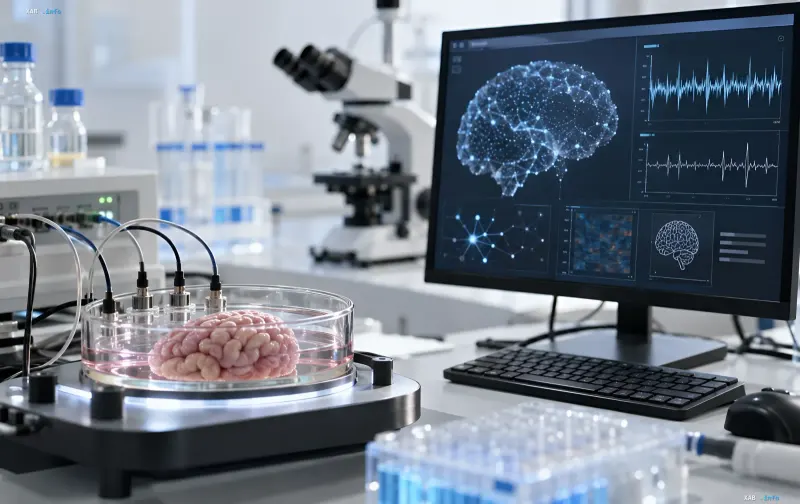
Artificial intelligence, researchers predict, will be able to run not only on silicon chips, but also on living human cells. This marks the formation of a new computing paradigm known in the scientific community as «wetware». Its foundation consists of organoids, or «mini-brains», grown in laboratory conditions from human stem cells, frequently derived from ordinary skin cells. The resulting clusters of living neurons are connected to a grid of electrodes, enabling the exchange of electrical signals with external devices and turning the tissue into a functional computing element.
How a «Mini-Brain» Begins to Think
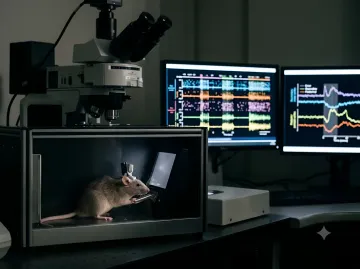
The key property of such structures is their electrical activity. Scientists explain that the signals generated by organoids resemble the brain waves of premature infants. It is precisely this biological «aliveness» that makes biocomputers exceptionally flexible: unlike rigidly programmed silicon circuits, neural networks are capable of adapting to tasks. In 2025, Cortical Labs unveiled the CL1 biocomputer, whose organoids learned to play iconic video games — specifically, the classic shooter Doom. This served as a clear demonstration that living tissue is capable of learning and responding to external stimuli.
From Entertainment to Medicine
The potential of wetware extends far beyond demonstration games. In medical research, organoids enable the study of autism development — when grown from the cells of patients with this condition — testing new drugs for Alzheimer's disease and epilepsy, and analyzing the impact of pharmaceuticals on memory. A living brain model gives scientists the opportunity to observe processes under conditions closely approximating reality, which is impossible with purely computer-based simulations.
Energy Efficiency Versus Silicon
One of the most promising properties of biological neural networks is energy efficiency. Unlike powerful AI servers that require massive amounts of power for operation and cooling, living neural networks consume a minuscule amount of energy to perform complex computations. For an industry where the energy consumption of large language models is becoming a primary constraint, this potentially alters the economics of the entire field.
Physical Limits and the Question of Consciousness
Despite the rapid development of the industry, scientists face physical and ethical constraints. The size of organoids is limited to approximately five millimeters in diameter due to the lack of blood vessels that could supply the tissue with nutrients. Simultaneously, a debate is underway regarding the potential emergence of consciousness in cultured tissues. Researchers at Johns Hopkins University note that there is currently no quantitative scientific definition of consciousness that could be applied to tissue in a Petri dish. Sociologists and philosophers from the University of California, San Diego add that consciousness is impossible without full sensory experience, and life in a glass flask does not provide a valid scope of perception of the outside world. Nevertheless, granting organoids access to cloud services and integrating them into robotic systems raise new philosophical questions that the scientific community has yet to answer.